

I am an administrative agent (행정사) with an office in Songdo, Yeonsu-gu, Incheon — a licensed specialist in administrative paperwork and in handling permit and notification procedures on a client's behalf. Here is one episode from my practice.
Sometimes the same person's hearing is read differently in two places.
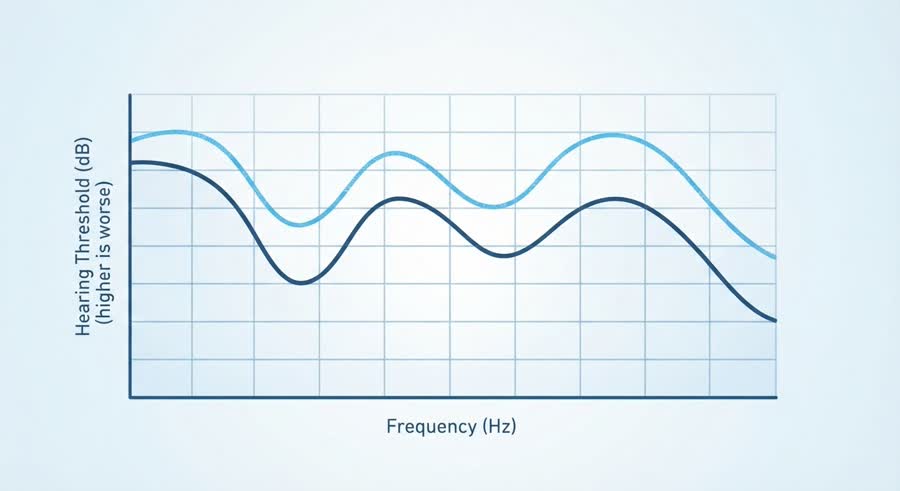
One test works like this: you hear a sound, you raise your hand. The other requires no hand at all — a machine reads the response coming from the brainstem. When the two figures diverge sharply, the determination usually follows the better number.
That gap divided thirty years of one man's life.
The eligibility was recognized, but it stalled at the grade
It began with an email. Two attachments: a notice recognizing eligibility, and a notice of the medical examination result.
The first document said he was recognized. The second said he had not reached the threshold for a disability grade. Two papers about the same man, giving exactly opposite impressions.
This combination is the most painful spot in veterans' affairs cases. The injury was recognized. Its connection to military service was recognized too. But if no grade is assigned, most of the practical effect of registration never arrives.
The client was a man in his late sixties. He enlisted in the late 1970s and served in the artillery, working a 155mm towed howitzer in the gunner's position. Live-fire training meant dozens of rounds at a time. In those days, in that position, he said, it was rare for anyone to wear ear protection properly.
After discharge he worked more than thirty years in a carpentry shop and a furniture factory. Now he works as a security guard at an apartment complex.
A few years ago his wife was diagnosed with early-stage Parkinson's disease. Once every two months they go to a university hospital. Each visit means medication and examination costs. A guard's wages left little room for two people's living expenses plus hospital bills.
Registration as a person of distinguished service brings support related to the use of veterans' hospitals. Support for a spouse varies with the grade and the eligibility conditions and must be confirmed with the competent veterans affairs branch office (보훈지청), but at the very least his own medical burden would change. He applied looking at that one thing.
And then it stalled at the grade.

Two months on his own
Two months passed before that email arrived. He had not spent those two months doing nothing.
The week after receiving the notice, he called the competent veterans affairs branch office and said he wanted to be examined again. The officer explained that a procedure called re-examination exists, and even told him where to find the application form. That was accurate guidance.
He downloaded the form and filled it in by hand. In the box for grounds, he wrote: "I really cannot hear well. Please examine me again."
He never submitted it. His son looked at it and said it probably shouldn't be filed that way.
Next he went to a neighborhood ENT clinic he had visited before, thinking a medical certificate would be enough. The clinic ran a hearing test and issued a certificate with a finding of hearing loss. It stated the diagnosis and his current condition.
But that document alone was not enough. The problem in the grade determination had never been "is there hearing loss?" The hearing loss was already recognized. The problem was that in the earlier examination two kinds of values had diverged — and the neighborhood clinic's certificate said nothing at all about that divergence.
This is usually where handling things alone breaks down. Not from a lack of effort, but from effort spent without knowing what the issue actually is.
He put the certificate in a drawer and let another month pass. Then, after hearing a passing remark from the head of the building management office, he began searching online.
At the end of that search came the email.
We started by counting days
At the first consultation, before opening any documents, I looked at the calendar.
Article 6-4 of the Act on Honorable Treatment of and Support for Persons of Distinguished Service to the State (「국가유공자 등 예우 및 지원에 관한 법률」) allows a person who disagrees with a medical examination determination to apply for re-examination within 60 days from the date of receiving the notice of the examination result. Sixty days is shorter than it sounds. Especially if you spend a few days discouraged, ask the people around you, then search the internet — a month simply goes.
I checked the date he received the notice. Fifty-one days had passed.
Nine days were left.
The client did not know this. When I asked whether the notice hadn't explained it, he said he had read it but it hadn't registered. He had stopped at the sentence saying he had not reached the grade threshold. After reading bad news, people rarely take in the paragraph below it.
At that point the order of the consultation was settled.
A first meeting is usually spent hearing the substance of the case. But in a case with a deadline closing in, the order has to be reversed. I first wrote on paper what absolutely had to be finished within the remaining nine days. Only then did I listen to the story.
Confirming whether the deadline is still alive is the first gate. If it is dead, the rest of the discussion is meaningless.

Opening the materials the decision was based on
The application had to be filed within nine days, but an application with no decision about what is being contested is just a properly formatted sheet of paper.
So I spent two days examining the underlying materials. Materials that served as the basis for a veterans affairs decision can, in some cases, be inspected or copied through the proper procedure. I checked with the competent branch office, made a request, and was able to review the materials relating to the examination result.
Two things showed up there.
First, eligibility was already recognized. That is, the connection between military service and the hearing damage had itself cleared review. That was a major asset. Many veterans affairs cases fail at this stage.
Second, the problem in the grade determination was not the size of the loss itself but the reliability of the figures. The value from pure-tone audiometry, which requires the person to respond, and the value from the objective test, which requires no response, diverged considerably — and in such a case the determination read as having been made conservatively.
When I told the client this, his reaction was fierce. Was I saying he had lied?
I told him that is not how I read it. Choosing the lower value at the review stage when results diverge is closer to the system's basic posture than to any individual officer's suspicion. There are criteria for determination, and when materials include data falling short of those criteria, things get sorted in that direction.
What mattered was not protesting the unfairness, but explaining why the two figures diverged.
The axis of the dispute was set then. We decided not to argue that "it is worse than that." Instead, we would explain "why it looked like a divergence."

Re-examination, or an administrative appeal
There were two routes.
One was re-examination: taking the test again. The other was an administrative appeal (행정심판) against the decision: contesting its illegality or unfairness.
The client initially wanted the administrative appeal. The word "adjudication" looked stronger.
I advised doing the re-examination first, for three reasons.
First, this case's problem lay not in the interpretation of the materials but in the materials themselves. If the two divergent figures were left as they were and we argued on logic alone, the review stage would be looking at those same materials. If he were examined again and the divergence resolved, that alone would change the conclusion.
Second, the deadline was still alive. Taking another road first, while a procedure available within 60 days sits right there, means closing the short road with your own hands.
Third, even if the re-examination result was poor, room would remain to move to the next stage. Conversely, filing an appeal first and receiving a dismissal could make that result a burden in later procedures.
In administrative matters, taking the short road first is generally right. Taking the short road does not close the long one; but taking the long road first sometimes makes the short one disappear.
I did make one thing clear, though: re-examination is not a procedure that can be repeated indefinitely. It has to be prepared properly the first time.

Why he paid for an examination himself first
This was the most important judgment in the case.
Re-examination is conducted at a designated hospital. We cannot take the test for him. But going in with no preparation made it highly likely that the same divergence would appear again — and this time there would be no way back.
So, separately from the application, I advised him to first get examined at a university hospital's ENT department at his own expense.
He hesitated. It cost money, and that result would not determine the grade anyway.
I explained it this way: the purpose of that examination was not to obtain a grade, but to identify the cause of the divergence. If he walked into the re-examination room without knowing the cause, the same result would come out, and at that point there would not even be a chance to explain.
Three tests were done.
Pure-tone audiometry, which depends on the person's own response. Objective tests including auditory brainstem response (ABR), which measure without any response. And a speech discrimination test, which looks not at pure tones but at how accurately speech is understood.
There was a reason for including the third. Hearing damage is not only a matter of magnitude. Sometimes sound is audible but words cannot be distinguished. The inconvenience people actually experience in daily life tends to come from here. What the client had said about repeatedly asking callers to say things again over the intercom at the guard post connected to this test.
The results took ten days. In the meantime, the re-examination application was filed within the deadline. File the application on its own schedule, supplement the materials afterwards — that was the order.

The left and the right were different
The day the results came, something unexpected appeared.
The degree of loss in the two ears differed considerably. The right was far worse.
I took that difference to the client and asked: at the firing position, where were you standing? And which side was the barrel on?
He gestured to show the posture. The gunner's position, the direction his body faced, which ear pointed toward the muzzle at the moment of firing.
The right.
Here is where care is required. Asserting the cause of hearing damage in a document is not our job. That belongs to doctors and to the reviewing body. The moment a document asserts a fact, it loses credibility.
So we did it this way. We wrote the fact that the difference between left and right was this much. We wrote his posture and position during service as his own statement. And we stated explicitly that the judgment about what this asymmetry means was left to the specialist's opinion and to the review.
Precisely because we did not write the conclusion, that material became raw material the deciding side could use within its own reasoning.
And something more important in practice: in grade determination, the figure for the worse ear carries great weight. What is invisible when the two ears are averaged together becomes visible when left and right are separated.
The answer was not in new material. It was in how the material was divided.

The reason for the wavering
On the day of the speech discrimination test, one more thing emerged in the examination room.
The client had had tinnitus for a long time, especially on the right. In a quiet room, he said, something like the sound of cicadas keeps going.
This had come up in the first consultation too. It had simply passed by as an incidental symptom. Most clients do not know which of the things they experience carries weight in a procedure. There is no reason they should. Picking that out is our side's work.
When tinnitus is severe, the threshold in a test requiring one's own response can waver. It becomes hard to tell whether you heard a very faint sound or a sound from inside your own ear. Conversely, in a test read by a machine, that influence is relatively smaller.
Here, room opened up to explain why the two figures had diverged.
I organized a set of requests and passed them to the doctor conducting the examination: that the opinion letter include a finding on the intensity and character of the tinnitus, and a medical opinion on how it might affect the performance of a subjective test. I did not ask for the conclusion we wanted. That must not be done, and when it is done, it shows.
The doctor wrote it out, separating observed facts from generally known effects. That separation was, in fact, more persuasive.
An impression of an "exaggerated response" is not erased by rebuttal. It vacates its place naturally when another explanation is set down beside it.

One sentence from the third consultation
The most decisive material was not something we found. It started from something the client mentioned in passing.
At the third consultation, while talking about the woodworking plant, he said: they tested ears there every year. The company told him to, so he did, and he thinks they gave him a result sheet, but he has no idea where it is.
I stopped the conversation there and asked again.
Workers at sites with severe noise receive special health examinations related to noise. And when first assigned to such a workplace, they receive a pre-placement health examination.
A pre-placement examination. Do you see what that means?
That point in time is after military service ended and before exposure to that plant's noise. Which means the state of his hearing at some point between the two was preserved as a record.
Why did this matter? Because one counterargument was bound to surface in this case sooner or later: he worked more than thirty years in a woodworking plant, so wasn't it the noise there? Since eligibility was already recognized, that argument was not in a position to be raised head-on — but in a dispute over the grade, there was plenty of room for it to lie in the background.
The pre-placement record blocks the path in front of that argument.
The problem was that the company had closed long ago. But the health examination was not conducted by the company; it was conducted by a medical examination institution. That institution still existed. Examination results have a set retention period, and old data may no longer exist, so I kept expectations low.
I called. After identity verification I requested a search, and three days later a reply came.
A pre-placement health examination record from the early 2000s still existed. At that point there was already a finding of loss in the high-frequency range.
That was before he entered the woodworking plant.
The reason this material did not surface at the first consultation is simple. To him it was "a test the company made me take," not evidence about his own hearing. People generally do not know the meaning of the materials they hold.
This material had limits too. How the degree of loss at that time compares with now, and what caused the changes over the intervening twenty-odd years, cannot be answered by that one sheet. In the statement of grounds, we wrote that limitation ourselves, first. When you submit material in your favor and disclose on your own what it cannot answer, the credibility of the whole document does not shake when the other side points at that spot. Conceding after being told, and writing it down before being told, are the same sentence with different weight.
Splitting four places across three days
While gathering materials there were four places to deal with: the competent veterans affairs branch office, the university hospital, the medical examination institution from twenty-odd years ago, and the military service window where his service records could be confirmed.
The client worked shifts. Days and nights alternated, and he could only move on his days off. On top of that, his wife's hospital appointment was fixed once every two months.
So instead of cramming everything into one day, we split it over three. The order was built so that whatever the next institution would require was obtained in advance from the previous one.
Day one handled the records search request at the examination institution and the military service documents. Both needed only identity verification, so they could be bundled into the same day. Day two was the university hospital examination. With three tests it took half a day, and we scheduled nothing else. On day three he stopped by the veterans affairs branch office to settle the filing and the confirmations.
We also separated what could be done by phone from what required going in person. The records search was handled by phone and post. Since the data was twenty years old, an immediate reply might not be possible, so this item was started first, letting other work proceed while we waited. Putting what requires waiting at the very front is the basic principle of schedule design.
This was the part the client later thanked me for most. Not because the outcome was good, he said, but because his days off had not been wasted.


The line we did not cross
Twice during this case I had to say that something was not our work.
The first was industrial accident compensation. Noise-induced hearing loss is also handled in industrial accident compensation procedures. He had over thirty years of work history at noisy sites, so he asked whether there was room to claim from that direction.
I thought there was a possibility. But that procedure is a separate case against the Korea Workers' Compensation and Welfare Service (근로복지공단).
I added one thing here: the two procedures are separate, but a statement made on one side can appear as material on the other. So what is said on both sides must not contradict. That point did in fact help later.
The second was the question of concurrent benefits — whether several forms of compensation can be received at once. The conditions differ case by case and it is not an area where anything can be asserted, so I advised him to confirm directly with the competent veterans affairs branch office. Manufacturing an answer to such a question in the office is not kindness; it is risk.
The scope of our work was clear: reviewing the materials underlying the decision, setting the axis of the dispute, drafting the re-examination application and the statement of grounds, collecting and arranging reference materials, and advising on preparation before the examination. That far, and no further.

The order of the application
Once the materials were in, we built the structure. The re-examination application itself follows a set form. The outcome turns on how the accompanying statement of grounds and reference materials are arranged.
We set the order like this.
A one-page table of contents at the very front. Then a two-page statement of grounds. The first paragraph of the statement gave the conclusion first: that there were explicable circumstances behind the divergence between the subjective and objective test values, and that materials allowing those circumstances to be verified were attached.
Next came the objective materials: the early-2000s pre-placement health examination record. The reason for placing it first is that it is not a material we created, but one a third-party institution created and kept more than twenty years ago. When you put a material whose authenticity cannot be contested at the front, the weight of everything that follows changes.
Next came the three university hospital test results and the specialist's opinion letter. The left-right asymmetry, speech discrimination, and the tinnitus findings go here.
Next came the service-related materials: the military service certificate, and his own written statement about his duty and posture during service.
Placing his own statement last was deliberate. A statement that comes after objective materials have been laid out reads as a sentence explaining those materials. Conversely, if the statement comes first, the materials behind it read as having been gathered to prop it up. The same documents — but the order changes the impression.
And nowhere in the statement of grounds did we ask for any particular grade. A grade is determined through examination and review; it is not something an applicant demands. Write a demand and the document becomes a complaint; write facts and it becomes evidence.

The day of the examination
Once the re-examination date was set, I organized the preparation into three points.
First, avoid noise exposure the day before and the day of the examination. Given the nature of guard work this could be difficult, so I had him adjust his shift schedule.
Second, do not exaggerate during the examination. And do not understate either. The second is harder. When a person feels wronged, they unconsciously start acting as though they cannot hear — and that may have been one cause of last time's divergence. I told him: if you hear it, raise your hand; if you don't, don't. The materials we prepared exist to explain that honest result, not to substitute for it.
Third, I asked him to keep a two-week record of daily life. How many times he asked a caller to repeat over the intercom; on how many days, and how many times, he failed to hear his wife calling. Not figures — scenes from a life.
There was a small commotion too. He got the examination date wrong by a day, went to the hospital the day before and came back, even though I had told him several times to call and confirm. The next day he arrived on time and said he had effectively had a rehearsal.

The result
After the re-examination and the review, a grade came: Grade 7.
It was lower than the client had hoped. During the consultations he had mentioned higher grades several times, and each time I told him the grade is not ours to set.
On the day I conveyed the result, he was silent for a long while, then asked whether he could contest it further.
I said I would not recommend it. Re-examination is not a procedure one undergoes repeatedly, and contesting further at this stage would mean going to an administrative appeal or beyond. But this determination had reflected a substantial part of the materials we submitted: separating left from right, acknowledging the circumstances behind the divergence, accepting the pre-placement record as evidence. Overturning a grade issued on that foundation would require new facts, and we had nothing further to submit.
If you hold on to the part you cannot win, you lose even the time you would spend protecting what you have already gained.
Grade 7 or not, registration is registration. Support related to the use of veterans' hospitals began. How the support items for his spouse would work out depends on the grade and income conditions, so I advised him to confirm directly with the competent veterans affairs branch office. He did, and some items applied while others did not.
The whole process took about five months: nine days to file the application, three weeks for the self-paid examination and gathering materials, and the remainder waiting for and undergoing the examination, then the review and the notice.

A wooden pen holder
A few weeks after the result, he stopped by briefly without an appointment. He had a paper bag in his hand.
Inside was a pen holder made of solid wood. He had made it himself. Thirty years of carpentry were all in that object. The edges were rounded smooth, and there was even anti-slip felt on the bottom.
That pen holder now sits on my desk at the office.
He said his daughter is getting married next spring. And he added one thing: these days he hears his wife calling better than before. His hearing has not improved. His wife simply started calling from a different direction — not from the right, but from the left.
He had lived that way for thirty years, and he learned it only after receiving a single sheet of test results.
The results of administrative procedures usually come out as numbers. But what those numbers change between people is usually not a number.

A few things to leave you with
If you are in a similar situation, I suggest this order.
① When a notice arrives, check the date first. Re-examination must be applied for within 60 days of receiving the notice of the examination result. The few weeks spent in discouragement consume that entire period.
② Recognition of eligibility and determination of grade are different stages. If you stalled at the grade, eligibility has already cleared — so don't spend your documents re-arguing eligibility. What you contest is the basis of the grade determination.
③ A divergence between subjective and objective test values becomes an issue in itself. Being re-examined without material explaining the cause of the divergence repeats the same result.
④ Look for old health examination records. Even if the workplace has closed, records sometimes remain with the examination institution. The retention period may have passed, so keep expectations low — but do check.
⑤ On examination day, respond honestly. Exaggeration brings the reliability problem back. Explain the unfairness in documents and take the test exactly as it is; that turns out to be more advantageous.
This case is a fictional story reconstructed to aid understanding. The text was reconstructed from actual consultation cases; the people, business names, place names, and figures appearing in it bear no relation to any specific individual or matter. A disability grade and whether eligibility conditions are met are decided through medical examination and review by the Veterans Affairs Review Board, so they cannot be asserted in advance in an individual case; support items and amounts vary with grade and income conditions and require confirmation with the competent veterans affairs (branch) office. For exact provisions and their interpretation, please check the Korean Law Information Center (law.go.kr) or the competent authority.