

Hello, I'm an administrative agent with an office in Songdo, Yeonsu-gu, Incheon. Let me introduce you to an episode I encountered while working, for my neighbors. 🙂
Since two systems changed this spring, the nature of inquiries regarding motorcycles has changed.
Previously, most questions were short, like "I lost my motorcycle license plate." But as summer approached, the questions became longer. Apps were freezing, insurance wasn't working, and the motorcycle registration wasn't in my name. These three sentences began to appear together in a single phone call.
This story is about one of those cases. On paper, it was a simple change of registration. In reality, it involved three names intertwined.

Two Changes That Happened to Motorcycles This Year
First, let me briefly summarize the background. If you know these two things, the rest of the story will make much more sense.
The first is the license plate. Starting March 20th of this year, the license plates for two-wheeled vehicles changed to a new standard. The city/province, city/county area designation on the top of the license plate was removed and replaced with a nationwide number, and the size increased vertically. The color of the letters also changed to something more visible. New motorcycles being registered and motorcycles receiving replacement license plates due to damage will receive a new license plate. Motorcycles already registered can continue to use their existing license plate and can apply for a replacement if they wish.
The second is the starting point of this story. The 「Living Logistics Service Industry Development Act」 was amended, and starting in June of this year, those working as delivery drivers must be enrolled in a paid delivery insurance (or indemnity) to be able to deliver. And delivery platforms and business locations are obligated to verify whether their affiliated riders are enrolled in insurance. Starting at the end of the year, those starting delivery will also be required to complete traffic safety education.
The intention is clear. If a motorcycle delivering for money has an accident while covered by a household insurance policy, the insurance policy often rejects compensation. This harm is passed on to both the rider and the party involved in the accident. The goal is to prevent this and also to reduce instances of people lending their registration for insurance or operating without insurance.
However, when a system begins "verification," things that have previously been overlooked are suddenly revealed.
The most common thing that has been revealed is the registration name.

The Day the App Froze
On a Monday morning in the second week of July, a phone call came.
He was a 28-year-old man living in Yeonsu-gu, Incheon, and working as a delivery driver in the Songdo and Yeonsu-dong areas. His voice was calm, but he spoke quickly. He said he hadn't been able to work for three weeks.
In mid-June, a "insurance verification required" message appeared on the delivery app, and a few days later, dispatching stopped. When he inquired with the business location, he received the answer that he needed to submit proof of paid delivery insurance to resume dispatching.
He immediately called the insurance company. That's where he encountered the first wall. The insurance company asked who the owner of the motorcycle was according to the vehicle registration certificate, and informed him that additional documents would be required if the owner and the person applying for insurance were different. There was no certificate in his name.
He was using some of the income from his monthly delivery earnings to pay for his mother's hospital bills. His mother was undergoing rehabilitation after knee surgery. He bought the motorcycle with money he had saved and it was difficult to find other work immediately besides delivery. Three weeks meant a missed month's worth of hospital bills.
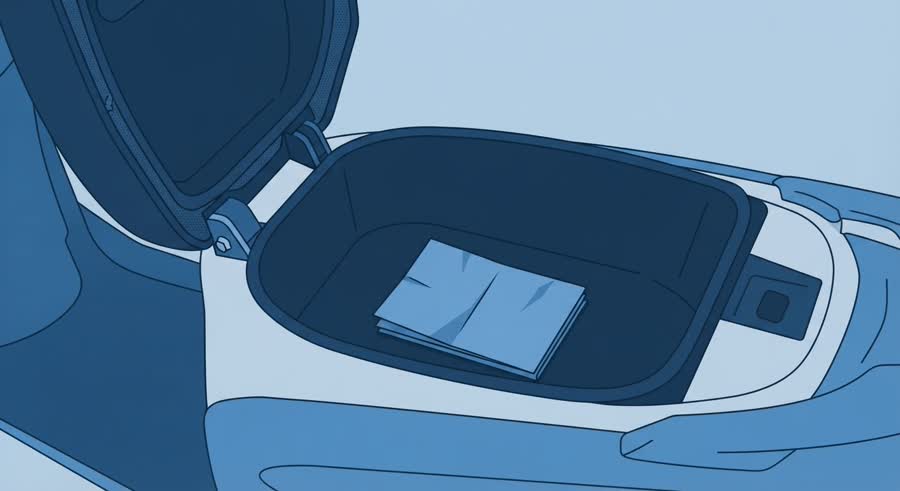
After asking a few questions over the phone and requesting that he send all the documents he had in photos first, I asked for the documents to be sent. A single sheet of paper folded under the motorcycle seat, a screenshot of the insurance certificate, messenger conversations from when he bought the motorcycle, and remittance records.
The photos arrived that evening. And the moment I unfolded the first photo, I realized this wasn't just an insurance issue.

The Third Name Written on the Certificate
The paper under the seat was a vehicle registration certificate. The name listed in the owner's field was not his name. It wasn't the name of the person who sold him the motorcycle either.
It was a completely different third name.
The next day, I inquired about the details over the phone. He said he bought the motorcycle in February of this year from a senior colleague he knew from his previous workplace. The senior was in his mid-thirties and moved to the Chungcheong region in April due to work. He said when they made the deal, the senior told him, "It's something my father gave me, so all the documents are here. Since it's under my father's insurance, you can just ride it."
The name on the certificate of registration was that of the senior’s father.
To summarize, the father gave the motorcycle to his son (the senior) about two years ago, and it wasn't reported at that time. The son then sold it to this rider in February of this year, and again, it wasn't reported. The documents showed the father had been the owner for two years, and the insurance was a household policy under the father’s name. The rider had been splitting the insurance premium through the senior.
He said he had never even unfolded the certificate. It was folded and tucked away in the under-seat storage compartment, and he believed the senior’s words, "all the documents are here." He didn't have the opportunity to realize the difference between "documents being present" and "documents being in my name."
After confirming this structure, the first thing I did was to list the order of what was dangerous. The app stopping was an inconvenience. But there was a bigger risk. For the past four months, he had been receiving payment for deliveries under someone else’s household insurance. If an accident had occurred during that time, the compensation issue would have become very complicated. Fortunately, there were no accidents. Therefore, this matter could be resolved as "fixing things while the app is stopped." 🛵
Since insurance terms and conditions and compensation judgments are the purview of the insurance company, I advised him to check directly with them. My job was to create a certificate of registration in his name through the shortest possible route.
Motorcycles are 'reported,' not 'registered'
Here's a point that many people get confused about.
With cars, you "register" them. There's a registration registry, and you need to transfer the registration before ownership is transferred. Motorcycles are a little different. Article 48 of the "Motor Vehicle Management Act" stipulates that a person who acquires and uses a two-wheeled vehicle shall report its use to the mayor, military district commander, or ward office, and upon receiving the report, shall designate a number and issue a two-wheeled vehicle use registration certificate. It also stipulates that a person who has received the transfer of ownership of a reported two-wheeled vehicle shall report the transfer of ownership.
In simpler terms, if you bought a motorcycle, the buyer needs to report it, and that report needs to be completed before your name appears on the certificate. It's not a structure where the seller simply passes it on.
There's also a deadline. According to the guidelines of various district offices, if ownership has changed, sales must be reported within 15 days, and gifts within 20 days. If the deadline is missed, a fine is imposed, and the amount increases depending on how long the deadline was exceeded, with an upper limit set according to the governing authority's guidelines.
And the fact that motorcycles are "reported" rather than "registered" gives people a false sense of security. It’s not as complicated as a car, so you can do it later, they think. In fact, the work itself is relatively simple at the counter. It finishes quickly if the documents are correct.
The problem was the condition "if the documents are correct." In this case, there were two people who needed to prepare those documents, and neither of them was actively involved in this matter at the time.

He Came on Tuesday with a Helmet
I scheduled an appointment for the Tuesday of that week in the afternoon. He arrived 10 minutes before the scheduled time. He was wearing a helmet on the side of his head, suggesting he had ridden his motorcycle.
About five minutes after he sat down and we started talking, a cheerful voice came from inside the helmet. "A new order has arrived."
We both stopped talking for a moment. It wasn't the app that had stopped, but the Bluetooth device attached to the helmet that was reading out other notifications that remained on his cell phone. He smiled sheepishly and turned off the helmet switch. "It's been three weeks since I heard that sound, so it's a welcome surprise." There was a brief moment of laughter in the office.
After that laughter, we got down to business. There were three things he had tried to do on his own.
One, he called the insurance company. He was told that verification of ownership was needed.
Two, contacting a senior. Initially, I received a reply saying, "I'll look into it," and after that, only message read receipts appeared.
Three, inquiring at the local community welfare center. The frontline staff informed me that a transfer of ownership certificate, a license plate certificate (필증), identification, and insurance confirmation were required, and that it would be difficult to file the report immediately with the current documents because the license plate certificate holder and the transferor are different. This was accurate information.
The frontline staff checks whether the documents meet the requirements. They cannot accept documents that do not meet the requirements. That's what the frontline staff does. The order in which to prepare documents that meet the requirements was something that the party filing the report would have to figure out in the next step.

A Cousin's Suggestion
There was a statement that person cautiously brought up during the consultation.
My cousin said that he has a motorcycle registered under his name, and he suggested that I get a paid transport insurance policy under his name and create a new app account under his name and work for a while. He said that his brother was okay with it.
I clearly stated that I would not recommend that method. There were three reasons.
Firstly, this is exactly what the new system is trying to prevent. The obligation to confirm insurance enrollment is intended to block people from using borrowed or stolen names to deliver goods. Accounts with borrowed names are unlikely to last long in the flow of strengthening verification by the platform, and if they are revealed, the issue will not end with just the account.
Secondly, insurance coverage is based on the actual operating motorcycle and the person operating it. If you get insurance under my cousin's name and ride a different motorcycle, the insurance may not cover this motorcycle in the event of an accident. It’s essentially recreating the problem in a different form.
Thirdly, this method doesn't address the root of the problem, which is the license plate certificate holder. You'll be facing the same wall again in a few months. This time, my cousin will be involved as well.
He nodded. He said he didn't really want to do it either, because he felt like he was imposing on his brother. We decided to stick to the original path. Instead, we decided to make that path as short as possible.

The Sequence Was Two Steps
That evening, I spread out the materials I received in photos and mapped out the path.
The first method that came to mind was to pass it directly from my father to the rider. It seemed the shortest because the documents would be completed in one go. It would also avoid involving the senior.
However, this motorcycle has actually changed ownership twice. From father to son, and from son to rider. The person who sent the money to the rider was not my father, but the senior, and the messenger conversations were with the senior. There was no transaction between my father and the rider. The two didn't even know each other.
A transfer of ownership certificate is a document that records who transferred ownership to whom. Writing a non-existent transaction in a document is not a convenient path, but a dangerous one. If a dispute arises with the senior later, or if the issue of fines is raised, there will be no way to explain if the documents and the actual situation do not match. I had already inquired with the relevant frontline staff, and received a response confirming that following the order of the transaction flow was the correct approach.
So, I divided the reporting into two steps: the first step from father to senior, and the second step from senior to rider. The goal was to submit both steps on the same day, at the same frontline office. If done separately, the senior would have to receive a license plate certificate under his name and then transfer it, which would double the schedule.
I also clearly indicated that the two steps have different natures. The first step was a gift from the father to the son, with no money involved. The second step was a sale involving money. The deadlines and the content to be written on the transfer of ownership certificate differ depending on the nature. If these are mixed, the frontline staff will ask you to rewrite the documents, which means you would have to get the documents from the senior again. Getting documents from the senior twice in this matter was almost impossible.
Administrative documents are the opposite of order. This time, the sequence was just two steps.

Which Comes First, Insurance or Reporting?
While mapping out the path, a second wall appeared.
The insurance company was trying to confirm the certificate of ownership holder. However, the previous registration channel required proof of insurance enrollment. It seemed you needed a certificate to get insurance, and you needed insurance to receive the certificate. It was like the chicken or the egg.
The crux of the problem for him was actually here. Both places weren't giving incorrect guidance. They were simply stating the requirements for their respective documents; when those requirements were layered on top of each other, there was no clear path forward.
I advised him to rephrase his question to the insurance company. Instead of "Will I be enrolled if the certificate isn't in my name?" he should ask, "If I'm about to transfer ownership via a transfer of ownership certificate, can I enroll in compulsory insurance in the name of the transferee before the transfer registration? I'll finalize the conditions for freight transport as soon as the certificate is issued."
He asked this question to two insurance companies, and one responded that there was a procedure to receive a copy of the transfer of ownership certificate and enroll first. Procedures vary by insurance company, so not all of them do this. However, you need to ask the question precisely to confirm whether that procedure exists.
This established the sequence. First, obtain two transfer of ownership certificates. Then, enroll in insurance with those. File both forms consecutively on the same day. Once the certificate is issued, immediately finalize the freight transport conditions and submit proof to the branch.
On paper, it was four lines. The problem was the first line. The transfer of ownership certificate required the signature of the transferring party—his father’s and his senior’s signatures.

Why the senior avoided contact
Dealing with his father was surprisingly smooth. He lived in Incheon and hadn't ridden the motorcycle since giving it to his son due to knee problems. He said he was surprised to receive speeding violation notices to himself a few months ago. The rider had received and paid all of those notices. Since the certificate holder was his father, it was natural for the notices to go to him.
His father said, "Please remove me from the name quickly." The reason was different, but the direction was the same.
Dealing with the senior was the problem. Despite several attempts through the rider, the response was slow. I advised him to guess why the senior was hesitating. People usually avoid signing documents when they don't know what the signature means for them.
The guess was correct. The senior eventually confided his worry: a fine. He hadn't reported the transfer of ownership more than two years ago when he received the motorcycle, so if he reported it now, a large fine would be levied against him.
This worry was justified. The obligation to register ownership transfer lies with the recipient. The senior was the recipient in the first step, from his father to him. Since two years had passed, the fine was likely to be close to the maximum amount according to the relevant guidelines.
I didn't hide this point, but instead organized it into options and numbers to present to the senior. I believed that vague worries paralyze people, but precise numbers lead to decisions.
The organized information was as follows: The fine has a maximum amount according to the relevant guidelines. Delaying the report won't reduce the amount. There is a pre-notification and opportunity to submit opinions before the fine is imposed, and there is a system to receive a reduction under the "Regulation of Disorderly Conduct" if you pay within the submission deadline. And if you don't report it now, the motorcycle will remain in his father’s name, and violation notices will continue to go to his father.
The rider added a line: he would pay half of the senior’s fine. He benefited from the motorcycle being sold cheaply, and he also hadn’t reported it. ⚠️ It was noted that this offer was an agreement between the two parties and had nothing to do with the legally stipulated burden ratio.
Two days later, I received a response from the senior: he would send the documents and sign them via registered mail.

Why we decided not to change the date
On the day we were drafting the documents, a temptation arose.
My senior casually mentioned during a phone call that perhaps we could just write this month's date on the transfer of ownership certificate to avoid a fine. The rider was briefly tempted by the idea.
I decided to use the actual date. The reason was simple: the transaction already had a record of the date. February's bank transfer history, the messenger conversation from the same day, and the delivery run records for four months before the verification process began in June. Moreover, a speeding ticket had already been sent to my father's address during that time. It was already established where and when this motorcycle was ridden.
Changing the document date in that situation would be a problem, as it would involve entering false information into an official document just to save a few tens of thousands of won in fines. An administrative agent cannot assist in preparing documents with such dates. And most importantly, the purpose of this was to "accurately" correct the ownership. Creating an inaccuracy would contradict the effort to do things correctly.
Instead, I gathered supporting documents for the actual date. If a pre-fine notification arrives, I intend to state the circumstances truthfully in a written opinion and explain the voluntary reporting. Rather than hiding the date, I decided to explain it.
I briefly informed my senior about this. The response was a single line: "Then just do it the original way."
Understanding regulations is easy; knowing when to invoke which regulation is difficult. This time, it was half the battle to remove the method that shouldn't have been used.
Should the License Plate Be Changed?
While the documents were being exchanged, the rider asked a question: should the license plate be changed to a new one while changing ownership?
As mentioned earlier, new standard license plates are mandatory for motorcycles that have a new usage declaration filed after March 20 or receive a re-issuance due to damage. Motorcycles already registered can use the existing license plate. This matter involved transferring ownership of an already registered motorcycle, not a new usage declaration. Moreover, the motorcycle was originally registered in Incheon Yeongu District, and the new owner's address is also in Yeongu District, so the jurisdiction hasn't even changed.
Therefore, I advised that the new registration and license plate replacement should be considered separately. Trying to change multiple things at once can delay the entire process if even one document is incorrect. The most urgent thing right now was the certificate of ownership name.
However, I did point out one thing: the existing license plate corner was quite bent, as seen in the photo. If the damage makes it difficult for speed cameras to read the number, it may be eligible for re-issuance, and at that time, it will be replaced with a new standard one. I suggested that once the ownership transfer is complete and there's some free time, they should check the condition of the license plate with the relevant authority.
He smiled, pretending to straighten the bent corner with his fingertips. It was a result of falling over in an alleyway last winter. This was a story my senior didn't know.
The Same Day, Two Entries
During the last week of July, all the documents were gathered.
My father came to the office to personally sign the transfer of ownership certificate. The senior's signed copy and the required power of attorney documents for the registration arrived by registered mail. I had already confirmed with the relevant department what was needed for the power of attorney registration, and the instructions sent to the senior were designed to simply check the boxes based on that confirmation. In a situation where documents cannot be received twice, the initial instructions determine the quality of the documents.
The day before, the rider had already completed the insurance enrollment using a copy of the transfer of ownership certificate.
On the day of registration, I submitted two applications consecutively to the relevant department. The first application was a gift from my father to the senior. The second application was a sale from the senior to the rider. The officer reviewed each document, confirmed the dates and signatures, and proceeded with the processing without comment, recognizing that the two applications were distinct.
That afternoon, the certificate of ownership with the rider's name appeared.
He held the certificate for a moment, just looking at the owner's name section. It was the same format as the form that had been folded under the seat for six months, but this time he unfolded it and checked the name first.
He immediately sent the certificate to the insurance company to confirm the paid transportation conditions and submitted the proof of enrollment to the agency. The dispatch reopened two days later. It had been five weeks since the app stopped working.

After the Pre-Notice Letter Arrived
In mid-August, the expected mail arrived. Pre-notice letters for fines were sent to both of them. For the rider, it was for the delayed post-sale reporting, and for the senior, it was for the delayed reporting after receiving a gift.
Here, I clarified the options again. 💡 Should you submit an opinion to challenge the penalty and try for a reduction, or pay voluntarily within the deadline to receive a mitigation?
I honestly stated my judgment. The reporting deadline had indeed been missed, and the seller's statement that "it's okay to just let it go" is unlikely to be a reason to waive the reporting obligation. The same goes for claiming ignorance of the law. In this situation, challenging the imposition itself would take time, and the chances of a different outcome were slim. Conversely, voluntary payment mitigation had clear and certain requirements.
Therefore, we decided on voluntary payment within the opinion submission deadline for the rider's portion. However, I prepared a one-page explanation of the circumstances. The transaction date, the fact that the certificate of title was registered in the name of a third party, the discovery of this fact during the verification process after the system change, and the subsequent self-reporting process. This record was not intended to change the amount of the fine. It was to allow someone to explain in a single page what this person knew and did when asked about the history of this motorcycle later.
The senior also made a voluntary payment in the same way. The rider sent half the amount as promised. The senior sent a short message saying he had finally properly seen the certificate of title paper for the first time thanks to this matter.
The result is this: the ownership was transferred twice according to the actual transaction flow, settled under the rider's name, and the paid delivery insurance was also signed under that name. The notification that used to go to his father would no longer be sent.
There was no reduction. Instead, there were no discrepancies left. Not a single place where the documents and reality didn't match.
Packed Tteokbokki
During the first week of September, he came to pick up the last documents. I decided to organize the original copy of the explanation of circumstances and a copy of the receipt into one envelope.
He was holding a plastic bag. He said it was from the delivery restaurant where he always orders tteokbokki. And he added a word. "This isn't a delivery; it's a takeout order. It's not a worry about insurance."
He said his mother was still undergoing rehabilitation. He said he was making up for the lost income for five weeks by increasing evening deliveries. He also brought up the topic of traffic safety education that riders starting from the end of the year will have to take. He said he looked into it to tell his colleagues, even though it didn't apply to him.
He said the certificate of title is now at the front of his mobile phone photo album, not under the seat. And the original is kept separately in a drawer at home.
Administrative procedures often stop a person's life for a whole month. Regaining that lost time often begins not with a brilliant solution, but by going through one's own steps.
A Few Things to Keep in Mind
📌 If you buy or receive a used motorcycle, please check the steps as follows.
① Check the certificate of title first. The first step is to verify whether the owner of the two-wheeled vehicle usage certificate is the same person as the person transferring the motorcycle now. If they are different, the transfer between them must be settled first before the transaction.
② The recipient makes the transfer report. Many places instruct that the report should be filed within 15 days for sales and 20 days for gifts. If the deadline is missed, the fine will increase depending on the period.
③ If you are delivering, check the insurance name and conditions. Starting in June of this year, delivery workers are required to have paid delivery insurance, and the platform verifies this. The certificate of title must be settled for the insurance to be properly signed.
④ Using someone else's name is just shifting the problem. Working with insurance or accounts under someone else's name can result in coverage discrepancies and is also a way that the system is trying to prevent.
⑤ Please write the transfer of ownership certificate date accurately. Changing the date to avoid a fine can create a bigger problem. If it's late, it's better to self-report and check for systems like voluntary payment reduction in the pre-notification stage.
The required documents and fine criteria for two-wheeled vehicle reporting, and whether or not to replace the license plate, may vary depending on the jurisdiction and individual circumstances. Insurance enrollment procedures and coverage range vary by insurance company, so please check directly with the insurance company you enroll with. Requirements vary from case to case, so individual verification is necessary.
This article is reconstructed based on actual consultation cases, and the characters, names, place names, and figures appearing therein are not related to any specific individual or event.
We are an administrative agent office located in Songdo, Incheon (Posco Tower Songdo). We handle administrative litigation, licensing/reporting agency, foreign entry and immigration (visas and residence), and regular administrative management for Incheon Yeongu-gu and surrounding areas. For motorcycles and automobiles, aligning the order of transactions is often more important than the documents, as it can affect the outcome.
━━━━━━━━━━
Hwang Yun-sang Administrative Agent Office
📍 165, Consia-daero, Yeongu-gu, Incheon, Posco Tower Songdo 2697
📞 010-3374-2687
🌐 www.hwangadmin.com
━━━━━━━━━━
#TwoWheeledVehicleUsageReport #TwoWheeledVehicleTransferReport #MotorcycleNameTransfer #UsedMotorcycle #DeliveryRider #CommercialTransportationInsurance #MotorcycleLicensePlate #TransferOfOwnershipCertificate #Fine #IncheonAdministrativeAgent #IncheonYeonguAdministrativeAgent #SongdoAdministrativeAgent #AdministrativeAgent
If you are curious about similar situations, feel free to leave an inquiry.
※ This is a fictional example reconstructed to aid understanding.