

I am an administrative agent based in Songdo, Yeonsu-gu, Incheon. I would like to introduce a principle I adhere to when handling permit applications, and share an anecdote of when that principle proved effective.
A permit isn't about receiving documents; it's about receiving the reality those documents represent.
An application is just a few sheets of paper. However, what the officer verifies as they review those papers is beyond the paper itself. Whether there’s actually an office at that address, whether that person is truly capable of doing the work, and who will truly be responsible if an accident occurs. Even if the documents are perfectly filled out, a supplementary request will come if the reality is empty. Conversely, if the reality is clear, the documents become simpler than you might think.
This story concerns a freight forwarding business permit. A truck owner who had driven a 1-ton truck for 11 years applied for a permit himself, saying "Now I want to do dispatching instead of driving," and received a two-line supplementary request. Those two lines were actually one problem, and behind that one problem, there was another trap he hadn't anticipated at all.

1. Overview of the Case — Why the 1-Ton Truck Owner Prepared for the Forwarding Business
1-1. First Came Three Photos
The initial contact came via text message. It included three photos. They were a supplementary request guidance notice from the district office, a copy of the permit application he submitted, and a document titled 'Business Center Address Use Contract.' A short message followed: "I applied for a freight forwarding permit, but they're asking me to supplement it. I don’t know what to fix.”
Just from the photos, I was able to complete half of the review. The supplementary request guidance notice listed two items: one was confirmation of the use rights of the main office, and the other was confirmation of the size of the main office. The deadline for supplementation was just under ten days from the date of the notice.
That evening, I had a phone call to hear the details, and scheduled a visit consultation for the following Tuesday afternoon.
1-2. The Client’s Circumstances
The client, a 39-year-old man, arrived on time for the appointment. He had been working as a 1-ton individual freight transport business owner for 11 years. He mostly transported food ingredients from the Incheon Logistics Center at 4 a.m. to restaurants and cafeterias throughout the metropolitan area.
He had two reasons to reduce his driving. He received an initial diagnosis of a herniated disc in the spring. The doctor advised him to reduce long hours of driving and loading/unloading. And his wife was due to give birth to their second child in December. Their first child was six years old. They both knew it would be difficult to manage the pre and post-natal period with a schedule of leaving at dawn and returning at night.
An opportunity arose. The logistics manager of a food distribution company he had been trading with for a long time wanted to assign all the increasing volume to one person. Dispatching several vehicles and settling freight charges. In other words, forwarding. There were two conditions: start on October 1st, and submit a copy of the freight forwarding business permit and a copy of the cargo liability insurance certificate before the contract.
His 11 years of accumulated client relationships and contact information of fellow truck owners were his assets. If the permit was approved on time, he could get out of the truck and sit behind a desk.

1-3. What I Tried on My Own, and the Roadblocks I Encountered
He had already taken the first step. During the third week of August, he compiled an application using internet information and experiences shared by colleagues. To save on costs, he contracted a virtual office, a business center that only provides an address. It was a place where he could use a business address for a few tens of thousands of won a month and have his mail received.
In reality, his workplace was his home. He thought he could set up a computer in the small room of his apartment and handle dispatching through phone calls and a freight information network app. Most of the dispatching work was done via phone and screen, so it wasn't entirely a wrong assumption.
The application was received. And a two-line supplementary request came back.
He misunderstood the two lines as separate issues. He thought the usage rights could be resolved by re-signing a contract, and the scale could be written down. So, he called the business center and said, "Please provide a contract with the area listed." The center seemed awkward. Since the address usage service doesn't include dedicated space, there was no area to list.
2. The Two Lines in the Supplementary Request — Actually, One Problem
2-1. My Initial Judgment — Should I Correct the Documents or Change the Office?
He read the supplementary request again. Usage rights and scale. The two items were listed separately, but they pointed to the same thing: Is there an actual office operating at this address?
Article 24, Paragraph 1 of the “Freight Motor Vehicle Transportation Business Act” stipulates that those who intend to operate a freight motor vehicle brokerage business shall obtain a permit in accordance with the regulations of the Ministry of Land, Infrastructure and Transport. In simpler terms, a brokerage business is not something that can be simply reported; it’s a permit issued by the government agency after verifying the requirements. And the application documents must include documents stating the name, location, and scale of the main office. The inspector’s visit to the office isn’t nitpicking; it’s part of the procedure.
The judgment he explained to the client that day was this: It won't be possible to overcome this supplementary request simply by re-signing a contract. This is because the address usage service is not originally a contract to rent 'space.' It wasn't a matter of correcting the documents; it was a matter of changing the office.
He was silent for a moment. It meant changing a contract costing a few tens of thousands of won a month to one costing several hundred thousands of won a month. However, if he postponed this decision, he would waste the ten-day supplementary period with document exchanges and eventually arrive at the same conclusion, which would be more expensive.

2-2. Why Didn’t the Agent Take My Home Address?
The client asked, "I work from home, so why can’t I just use my home address?"
This question comes up frequently in practice. The short answer is that it’s difficult to recommend. It’s tricky to explain the independent space and intended use of a residential apartment as an office, and there are cases where it’s simply impossible to have a business address due to management regulations or building usage issues. Above all, it’s difficult to demonstrate the character of a business hub where shippers and carriers come and go and documents are stored.
The agent in the field moves according to the established verification items. They check if there’s a space, if there’s the right to use that space, and if it’s the right size for the business. This standard isn’t something that can be left to individual discretion. It’s not wrong to follow the manual; the faster route is for the applicant to know and match those verification items in advance.
In administration, it’s always faster to fit the standard than to change it.
3. What is a Freight Forwarding Brokerage Business? — What Permits Do You Need?
3-1. Differences Between Freight Transport, Brokerage, and Franchising Businesses
Before we seriously started looking at offices, I re-explained the concepts with the client. Even a 11-year veteran carrier often can’t clearly articulate this distinction.
| Category | What It Does | Vehicle Ownership | Key Verification Items |
|---|---|---|---|
| Freight Truck Transport Business | Carries other people’s cargo using your own trucks for a fee | Required | Vehicles, depot, supply standards |
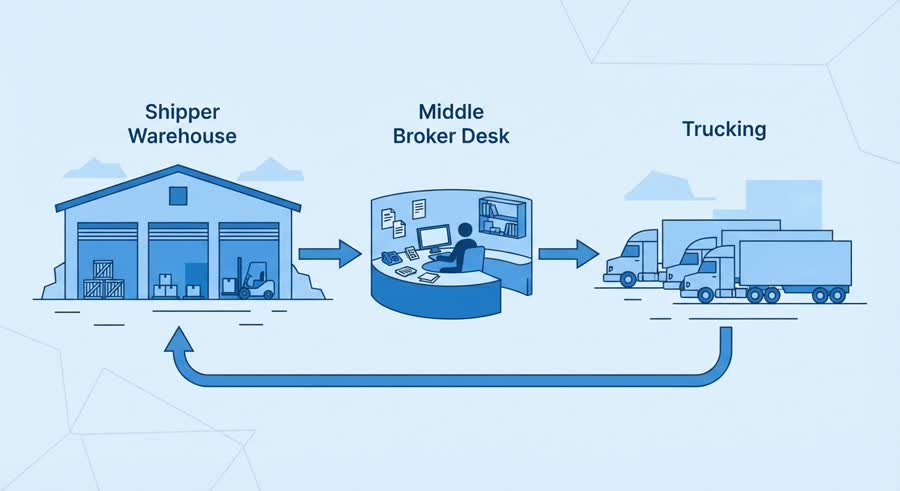
| Freight Truck Brokerage Business | Acts as an intermediary or agent between shippers and carriers, or uses transport vehicles under its own name to arrange transportation | Not Required | Office, cargo liability insurance |
| Freight Truck Franchising Business | Operates a network of franchise locations for both transport and brokerage | Sometimes | Separate permit criteria |
The client’s plan was a second endeavor. It involved dispatching food supplies to the vehicles of fellow truckers, billing the shipper for freight charges, and settling those charges with the truckers. The structure was to maintain their existing 1-ton truck transport business while simultaneously running a brokerage business.
3-2. What Follows Even After Obtaining a Permit
Article 24 doesn’t just address obtaining a permit. If you change the permitted details, you must report it, and if you operate outside of the main office, you need a separate business location permit. In other words, if you move offices or later decide to have a small dispatch office near a logistics park, there will be procedures to follow each time.
The client pointed out one thing after hearing this explanation. So, if you just temporarily secure an office and then move, do you have to report it again? Yes. That’s why we decided to choose an office that could be used for at least 1-2 years, not a temporary office just for obtaining the permit, but an actual office for dispatching.
3-3. What Changes When You Handle Relocation Goods
Brokerage businesses are often categorized into general freight brokerage and relocation goods brokerage. When brokering relocation goods, additional documents are required, such as proof of employing regular workers. The client planned to handle only general freight like food supplies, so this didn’t apply. However, to avoid unnecessary supplementary requests, we decided to clearly state general freight brokerage in the business scope section of the application from the beginning.
4. The First Trap — An Office with Just an Address
4-1. A Non-Resident Office and a Shared Office Private Room are Different
We narrowed down the office candidates to three.
- A. Maintaining a Non-Resident (Address Use) Service — Lowest cost. No dedicated space. This was the cause of the recent request for supplementation.
- B. Shared Office Private 1-Person Room — An independent room with a lock. The monthly usage fee is several times that of A. Whether the contract can specify the room number and area is key.
- C. Renting a Small General Office — The most straightforward option, but involves deposit, management fees, and a long contract period.
Considering the client’s finances and the date of October 1st, B was the most realistic option. However, there were three things to check when choosing B.

4-2. A Second Judgment — Three Things to Check When Choosing a Coworking Space
Firstly, Does the contract specify a room number and area? Some coworking spaces offer a "membership contract" that only provides a right to use a seat without specifying the space. It's difficult to explain both usage rights and scale with such a contract. Therefore, my first question when making phone inquiries was, "Does the contract include the room number and exclusive area?" This single question eliminated three out of five candidates.
Secondly, Is the coworking space operator leasing from the building owner and then subleasing? This is usually the case. In this situation, I inquired in advance whether I could obtain documents demonstrating that the operator has the authority to provide the space as a business location, such as a sublease consent confirmation or a business location provision confirmation from the operator. This document is often required when registering a business, so obtaining it upfront saves a second trip.
Thirdly, Is the building's purpose suitable for office use? I checked the building permit to confirm the purpose of the relevant floor. If the purpose is for business facilities or offices, the explanation is straightforward.
These three points are not about making documents look pretty. They involve anticipating what the agent will check and securing those answers during the contract stage. It's a completely different amount of time to search for documents after receiving a supplementary request versus setting conditions before signing the contract.
4-3. The Result — A Dedicated 100 sq ft Room Near Songdo
Three days later, the client signed a contract for a dedicated 1-person room in a coworking space that was a 20-minute drive to the logistics park. The contract included the room number and exclusive area, and the operator agreed to issue a business location provision confirmation. It was a room with one window and space for one desk and two chairs.
He looked around the room and said, "It's wider than a truck driver's seat."
5. A Second Trap — "My car is 1 ton, so it's not covered by insurance, right?"
5-1. A Sentence That Came Up During a Conversation
On the day the office issue was resolved, I brought up the discussion of the client’s requirements. A copy of the license and a copy of the cargo liability insurance certificate. The client said casually, "Cargo insurance is mandatory only for vehicles over 5 tons, so my 1-ton car doesn't apply. I think I can just submit my car insurance certificate to the client."
This sentence was the second trap. It was half right and half wrong.
He didn't hide the fact that he hadn't brought this up initially. He simply didn't feel the need to verify it because the information he had heard over 11 years as a transport business operator was correct. The problem was that he was now both a transport business operator and a broker.

5-2. A Third Judgment — Same Article, Different Obligated Parties
Article 35 of the 「Freight Motor Transport Business Act」 stipulates mandatory enrollment in cargo liability insurance, etc.. It states that operators must enroll in cargo liability insurance or a mutual aid fund to fulfill liability for loss, damage, or delay in delivery of cargo.
Here, the obligated parties are divided into two.
- Transport Operator: Applies to those who own general-purpose, van-type, or special-purpose cargo vehicles, or towing special vehicles with a maximum load capacity of 5 tons or more, or a total weight of 10 tons or more. This is based on vehicle criteria. The "5 tons or more" that the client knew about refers to this part.
- Transport Broker Operator: Not based on vehicle criteria. The obligation to enroll arises on a business unit basis.
The coverage limit must be at least 20 million won per incident as stipulated in the Enforcement Decree. In simpler terms, the client's 1-ton truck transport business may still not be an obligated party, but the moment they obtain a transport broker business license, they must separately take care of cargo liability insurance for transport brokers.
The certificate requested by the client was also this. Food ingredients incur losses if the temperature control is disrupted or the delivery is delayed. From the shipper's perspective, whether the transport broker entrusted with dispatching can be held responsible for those losses was a prerequisite for the contract. The standard automobile insurance certificate could not answer that question.
5-3. Why Was It Important to Anticipate This Trap?
What if this fact was discovered after receiving the license, on the day of submitting documents to the client? It takes several days to request a quote from the insurance company, explain the business details and handled items, go through underwriting review, and receive the certificate. October 1st would pass by.
Therefore, insurance was decided to be prepared in parallel with the license. Before the license was issued, quotes were obtained from two insurance companies for cargo liability insurance for transport brokers, and the handled items (including refrigerated and frozen food ingredients), the estimated number of annual shipments, and the coverage limit were confirmed in advance. So that they could apply immediately on the day the license number was issued.
Knowing the regulations is less useful than knowing when those regulations will trip you up.
6. An Unexpected Complication — The Old Post About Capital of 150 Million Won
6-1. The Money He Was Going to Borrow from His Brother-in-Law
On the second consultation, the client cautiously brought up one thing. He said he had arranged the capital issue with his brother-in-law. He had found on the internet that obtaining a transport broker license requires capital or asset valuation of 150 million won or more, and that a colleague who received a license a few years ago had struggled with the balance certificate. He was going to borrow money from his brother-in-law for a while, deposit it into his bank account, and obtain a balance certificate.
He considered this to be unrelated to the supplementary requirements. Since the supplementary requirements did not mention capital, he thought it was simply that he hadn't yet submitted something that was originally required.

6-2. Fourth Judgment — Confirming the Change in Criteria
I checked when the article was written. It was several years ago. And during that time, the criteria had changed.
The 「Freight Motor Vehicle Transportation Business Act Enforcement Rule」 was amended on July 1, 2019, removing the capital or asset valuation criteria from the licensing standards for freight forwarding and transportation affiliation businesses. This was a measure aligned with the legal amendment, intended to lower barriers to entry.
My colleague's ordeal with the balance verification was a story from before that time. My colleague's experience wasn't wrong, but the timing was different.
The client put down his cell phone, which he was about to call his nephew. The unnecessary risk of creating a balance with money, not actual funds, and the burden between the two people, as well as the interest accrued during the few days the borrowed money was deposited, all disappeared at once.
6-3. Why Old Information is Dangerous
Permit information has an expiration date. Being high in search results doesn't guarantee that an article is the most up-to-date. Especially in the freight sector, supply criteria, licensing requirements, and reporting forms have been revised several times.
This kind of verification is an often-overlooked part of an administrative agent's work. As much as informing clients what to prepare, filtering out what they don't need to prepare saves clients' time and money. This time, the difference was a request worth 150 million won.
However, just because the capital requirement has been eliminated doesn't mean the application can be written lightly. The business plan, office, insurance, and disqualification verification remain unchanged. A reduction in requirements means preparation is easier, not that verification has disappeared.
7. Reorganizing the Sequence — Counting Backwards from October 1st
7-1. Fifth Judgment — Countdown Table
The remaining issue was time. Supplementary period, licensing processing period, business registration industry addition, insurance subscription, freight information network broker affiliation, and client contract. These six items were counted backwards from October 1st.
| Timing | Tasks | Reason |
|---|---|---|
| Two Days Before Supplement Deadline | Submit supplementary documents including new office lease agreement, confirmation, and building information certificate | To avoid being rushed and to have time to answer any additional questions |
| Immediately After Supplement Submission | Inform the contact person of the possible schedule for an on-site inspection | To shorten the inspection schedule by a day |
| While Permit is Being Processed | Finalize insurance quotes, review draft of contract with clients | To complete tasks that will be done after the permit is issued |
| On the Day of Permit Receipt | Apply for insurance, apply to add business registration industry | These two documents are a prerequisite for submission to clients |
| 2~3 Days After Receipt | Convert to a freight information network broker member, submit documents to clients | To prepare dispatching tools |
| October 1st | First dispatch | Goal |
The reason for creating this table is simple: to distinguish between tasks that must wait for each other and those that can be done simultaneously. Finalizing insurance quotes and reviewing contracts do not require waiting for the permit. Conversely, adding a business registration industry and applying for insurance require the permit. If this distinction is blurred, a delay in one task can cause a domino effect of delays in all tasks.
Administrative documents are the opposite of that.

7-2. Sixteenth Judgment — The Reason for Stopping 'Dispatching' Before Authorization
While creating a reverse table, I confirmed something else. The client had already been passing on calls to fellow truckers for months. He was connecting drivers to those who could handle the volume he couldn't. He said he wasn't receiving any money for it.
It’s not difficult to be penalized simply for connecting colleagues without compensation. However, things change when a new contract with a client begins. The moment he receives freight charges from the client and distributes them to the drivers, keeping the difference, it becomes a brokerage business. Starting that business without authorization constitutes operating before authorization.
Therefore, we stipulated that the effective date of the client contract draft be after the authorization certificate is issued. If the client requested urgent shipments before October 1st, those jobs would be handled as the client’s own 1-ton truck transportation, as before. We also recommended that the contract specify separate items for the settlement of transportation and brokerage services. If the time comes to explain where the money came from, the contract will provide the answer first.
This wasn’t a trick to obtain authorization, but a preparation to remain stable after authorization.
8. Reapplication and On-Site Verification
8-1. Seventeenth Judgment — Adding a Page to the Supplementary Documents
We submitted the supplementary documents two days before the deadline. This included the lease agreement for the new office, the operating company’s confirmation of business premises, the building registry, and one additional page: a supplementary explanation.
The explanation detailed four points: the circumstances surrounding the address usage service contract at the time of the initial application, the fact that the office was moved to a dedicated room in response to a request for supplementation, the room number and area of the new office, and the time slots during which an on-site verification could be conducted at any time.
The reason for adding this page was to consider the situation from the inspector’s perspective. The inspector’s desk receives a second application from the same person. The first and second addresses are different. If the inspector has to call separately to ask why it changed and whether the new address is reliable, the processing will be delayed accordingly. Providing the answer beforehand will speed up the judgment.
On the day of submission, the inspector reviewed the explanation and scheduled the on-site verification date on the spot: next Wednesday morning.

8-2. On-Site Verification Day
On Wednesday morning, the client was already waiting at the office an hour before the scheduled time. The desk was organized with a computer, telephone, a draft of the client contract, and a list of fellow truckers’ vehicles. A map of Incheon and the metropolitan area was posted on the wall. The delivery routes that had been in his mind for 11 years were finally written down on paper.
The verification was brief. The inspector compared the room number with the room number on the contract, looked around the space, and asked a few questions. He inquired about the types of freight he planned to broker and whether he handled household goods. After hearing the answer that he primarily handles food supplies and printed materials, the verification was complete.
8-3. A Box of Peaches
Two days after the verification was completed, the client stopped by the office, holding a box of peaches.
He said they were rejected from the client’s warehouse due to blemishes. Although they couldn’t be sold, the taste was still good, and a logistics employee had given them to him, with half to be kept at home and half brought to the office. As befitting someone who has been transporting food supplies for 11 years, the box was securely packaged. The tape was wrapped in three layers and took a while to cut through with a knife.
He smiled sheepishly and added, "Now, I won’t be loading these peaches myself; I’ll be dispatching them."

9. After Authorization — The Time Remaining Until the First Dispatch
9-1. What Was Done on the Day the Authorization Certificate Came Out
The authorization certificate was issued in late September. As per the reverse calculation, we proceeded with two things simultaneously that afternoon.
- Cargo Liability Insurance Application: Finalized with one of the previously obtained quotes. We entered the authorization certificate number and business address and applied; the insurance certificate arrived two days later.
- Adding Business Registration Industry: Application to add the brokerage industry to the existing freight forwarding business registration. The shared office operator's confirmation was also used here.
Three days later, we completed the freight information network broker membership conversion and sent copies of the authorization certificate and insurance certificate to our clients.
9-2. Management Points to Take Care of After Authorization
Authorization is not the end, but the beginning. The note I left for the client was four lines long.
- Change Notification if Moving the Office. This may apply even if the room number changes when renewing the shared office contract.
- Business Branch License Required if Having a Permanent Dispatch Space Elsewhere. If you are thinking of securing a space near the logistics park, check this first.
- Manage Cargo Liability Insurance Renewal Date. To prevent a period of operation without insurance.
- Separate Settlement of Transportation and Brokerage. Do not mix your own 1-ton truck transportation and brokerage fees.

10. Results — From Truck to Desk
During the first week of October, the first shipment went out. We divided the client's volume among three fellow truck drivers. The client was sitting at their desk in the office at four in the morning instead of at the logistics center. They said six phones were ringing simultaneously.
It took about a month to receive the permit, from the first contact to the actual receipt. Counting from the point where we received supplementary requests, it was about three weeks. We kept the October 1st deadline with the client.
I didn't dispose of my own 1-ton truck. Instead, I reduced my operating days from five days a week to two days a week. On days with a lot of volume, I go directly to a few nearby cafeterias. My back treatment is continuing with weekly physical therapy.
In mid-December, I received a message saying that my second child was born. They said they were together at the hospital on the day of the birth. The dispatch was done from the hospital hallway using a mobile phone.
The permit changed not only the form of the business but also brought a day of a person who used to be on the road at dawn a little closer to their family.
11. A Quick Look at Freight Permits — Freight Transport Business, Brokerage Business, Transfer of Rights
11-1. Freight Transport Business Permit and Brokerage Business Permit
Even though it's the same 'freight permit,' the preparations are completely different.
| Item | Freight Transport Business Permit | Freight Brokerage Business Permit |
|---|---|---|
| Key Target | Vehicle (commercial license plate) · Depot | Office · Scope of Business |
| Capital Requirement | Centered on vehicles and facilities | Deleted capital and asset valuation standards due to amendments implemented in July 2019 |
| Cargo Liability Insurance | Mandatory for certain vehicles of 5 tons or more | Mandatory for businesses |
| When Changes Occur | Change permit · Change report | Report of changes to permit details, permit for business offices |
| Commonly Encountered Points | e="border:1px solid #d0d7de;padding:8px;">Supply Criteria, Parking Location | Office Existence, Insurance |
11-2. Transfer and Acquisition of a Freight Transportation Business is Another Story
A freight transportation business is often restricted from obtaining a new permit due to vehicle supply criteria, so it's common to enter the business through the process of transfer and acquisition from an existing business owner. In this case, it's not enough to simply transfer vehicle registration; the business right transfer process must also proceed. If you miss the business procedures while only transferring the vehicle, the basis for using a commercial license plate can be jeopardized.
On the other hand, a brokerage business doesn't require vehicles, so it's generally common to start with a new permit. If the client is structured with a transportation business and a brokerage business, you must manage the permits, insurance, and settlements for both businesses separately.

12. Frequently Asked Questions (FAQ)
Q1. Can I obtain a freight transportation brokerage business permit using a virtual office (address usage service)?
It's safer to assume it's difficult. The application requires specifying the location and size of the main office, and the authorities will verify the actual usage space and usage rights. Address usage contracts that don't specify a dedicated space often lead to requests for supplementation. If you use a coworking space, it's better to choose a dedicated room with a specific room number and dedicated area in the contract.
Q2. I saw a post saying that 150 million won in capital is required for a brokerage business permit.
That's the previous standard. The Implementing Regulations, revised and put into effect on July 1, 2019, removed the capital or asset evaluation standard from the freight brokerage business permit criteria. Be sure to check the publication date of the articles you find, and you don't need to borrow money to create a balance.
Q3. My car is a 1-ton truck. Do I need to join cargo liability insurance if I do brokerage business?
Yes, you have an obligation to join. The obligation for a transportation business operator is based on certain vehicles of 5 tons or more, but a transportation brokerage business operator must join on a business unit basis, regardless of the vehicle. The compensation limit should be 20 million won or more per incident. Getting a quote beforehand allows you to apply immediately after the permit is issued.
Q4. Can I arrange shipments before the permit is issued?
Receiving freight charges before the permit and dispatching them to other drivers can be considered unauthorized brokerage business. If you enter into a contract with a client, specify the effective date as after the permit is issued, and draw a line by handling only the shipments with your own vehicle before that date.
Q5. What if I move my office after obtaining a permit or want to have another location?
If you want to change the permit conditions, you must file a change report, and if you want to operate from a place other than the main office, you must obtain a business branch permit. Even changing the room number in a coworking space is considered a change, so check beforehand before renewing the contract.

## 13. In Situations Like These — Practical Checklist
① First, check your office space. Is it a contract for just the address, or a dedicated space with a specific room number and area? Review the contract wording before applying for the permit.
② Check the dates on internet articles. Many people waste time and money preparing requirements that have already been deleted, such as capital and asset valuation criteria.
③ Determine cargo liability insurance based on 'your business type,' not 'your vehicle's tonnage. Brokers are covered regardless of vehicles.
④ Separate tasks before and after the permit. Insurance quotes and contract reviews should be done before the permit, and insurance applications and business registration industry additions should be done immediately after.
⑤ If you do both transportation and brokerage, separate settlements. Dividing items at the contract stage makes explanations easier later.

The requirements and application documents for a freight forwarding brokerage license, and the scope of cargo liability insurance coverage, may change due to revisions and may vary depending on the business type. Requirements may vary depending on the case, so individual confirmation from the relevant authority is necessary.
Looking back, the answer to this matter was the original principle all along. Even the two lines in the supplementary request and the insurance certificate requested by the client were asking the same question. Is this business truly in place, and can you truly be held responsible if an accident occurs? Answering that question with substance rather than documents left only the matter of sequence.
This article is reconstructed based on actual consultation cases, and the characters, names, and figures appearing therein are not related to any specific individuals or events.
This administrative agent office is located in Songdo, Incheon (Posco Tower Songdo). We handle administrative litigation, permits/registrations, foreign entry and residence (visas and stay), and regular administrative management. For permits like freight forwarding brokerage, where the order of preparation often dictates the schedule more than the requirements themselves, it is the fastest way to align the office, insurance, and contract timing all at once before applying.
━━━━━━━━━━
Hwang Yun-sang Administrative Agent Office
📍 165, Conventionia Road, Yeongsu-gu, Incheon, Posco Tower Songdo 2697
📞 010-3374-2687
🌐 www.hwangadmin.com
━━━━━━━━━━
#freightforwardingbrokerage #freightbrokeragelicense #transportbrokeragelicense #cargoliabilityinsurance #freighttruckingact #1tontruck #freighttransportbusiness #sharedoffice #permits #administrativeagent #incheonadministrativeagent #songdoadministrativeagent
Feel free to inquire if you are experiencing similar situations.
※ This is a hypothetical example reconstructed to aid understanding.