

--- title: [Procurement Administration] Rejection and Reapplication Process for Direct Production Confirmation — When Documents Pass But the On-Site Inspection Fails ---
I am an administrative agent based in Songdo, Yeonsu-gu, Incheon. I’d like to share an episode I encountered while working.
The 'Production Facilities' section of the on-site investigation result form contained a single line. "Lack of bending machine among essential production facilities. External processing of bending process confirmed." Another line was written in the 'Production Personnel' section. "Out of the 4 applicants, 2 were confirmed as registered with the workplace."
The assessment section was 'Ineligible'. This was an application that had no problems at the document submission stage. The business registration certificate, building certificate, and four major insurance records were all submitted on time. However, the result was overturned after the investigator visited the factory.
This story concerns the Direct Production Confirmation Application for Products Procured from Small and Medium-Sized Enterprises. It’s about a small metal processing factory that prepared to supply to a public institution, attempted to apply on their own, was rejected during the on-site inspection, and then supplemented the equipment and personnel to reapply. The two lines in the result form appeared to be separate issues, but upon closer examination, a third problem was hidden behind them.

## 1. The Case Outline — A Small Factory Preparing for Public Procurement
### 1-1. The First Thing Received Was a Screenshot of the Result Sheet
The initial contact was via email. There were two attachments. A screenshot of the status investigation result screen downloaded from the public procurement system, and a list of application documents submitted by the client. The body of the email was short: "I submitted all the documents, but it was deemed unsuitable. I don't know if I can reapply or what I need to fix."
The evening I received the email, I read the result sheet twice and sent a reply. I scheduled a consultation for Thursday afternoon and requested they send me three items beforehand: the building permit for the factory building, the withholding tax payment status report for the past three months, and photos of the factory interior from entrance to end.
Why photos? The two lines listed on the result sheet are facts confirmed on-site. You can't tell what was seen on-site just by looking at the documents. I needed to see what the investigator saw.
### 1-2. The Client's Circumstances
The client was a representative in his late 30s. He inherited a metalworking factory from his father three years ago, a factory his father had operated for over 20 years in the central industrial area of Incheon. There are four employees excluding the representative. Their main product is iron shelves and storage cabinets supplied to interior design companies.
The problem was the client's business partner. The orders from the largest client, an interior design company, had decreased by almost half in just one year. Factory rent and the salaries of four employees remained the same. The representative's breakthrough was public procurement. There is a consistent demand for iron storage cabinets for schools, district offices, and public institutions. It’s less affected by economic fluctuations.
However, when he opened the bidding announcement, there was a line attached to the eligibility requirements. It stated that it was a product for competition between small and medium-sized enterprises and that only companies holding a direct production confirmation certificate could participate. The representative wanted to attend a regional public procurement consultation fair that autumn. To meet with the responsible person from the ordering agency at the fair, he needed to at least have the certificate in hand.
### 1-3. What He Tried to Do Alone, and Where He Hit a Wall
The representative proceeded with the application on his own. He registered on the public procurement comprehensive information network, selected the items, and gathered documents by reading internet articles. The document review passed smoothly. A few weeks later, an investigator from the association visited the factory. The investigator toured the factory for about an hour, inspected the equipment, and asked a few workers what they were doing. Then the result sheet came out.
The representative initially tried to raise an objection. He had been outsourcing bending work for a long time to a nearby company, and he had heard from an acquaintance that another owner was outsourcing part of the process and received a certificate. There was also an issue with personnel. All four employees come to the factory every day. However, two of them had requested to be treated as 3.3% business income when they were hired.
The problem, however, lay elsewhere.

## 2. What is Direct Production Confirmation? — A System for Verifying Production
### 2-1. Competition Products Among Small and Medium Enterprises and Direct Production Confirmation
Public institutions purchase some goods designated as competition products among small and medium enterprises. These items are, in principle, only to be supplied by small and medium enterprises competing with each other, preventing large corporations or imported products from entering the market. The current notice applies from 2025 to 2027 and designates 610 items. Because many items have limiting conditions attached in parentheses in the item name, you must first confirm whether your company's products actually qualify.
Protection comes with conditions. To ensure the intent of the system – that small and medium enterprises compete – the company that wins the bid must actually manufacture the goods. If a company simply receives the bid and supplies products from another company or subcontracts the work, the system is undermined. Therefore, before participating in bidding, companies must obtain confirmation that "this company has the ability to directly produce this product." This is direct production confirmation.
Article 9 of the 「Act on Promoting Purchase and Supporting Marketing of Small and Medium Enterprise Products」 (Marketing Support Act) requires confirmation of the direct production status of small and medium enterprises participating in bidding among small and medium enterprises, and Paragraph 4 of the same article stipulates the issuance of a certificate with an expiration date to small and medium enterprises that have been confirmed for direct production. Simply put, it means providing a ticket for entry into public institution bidding with a time limit.
### 2-2. What Criteria Are Used for Judgment? — Item-Specific Confirmation Criteria
The judgment criteria are outlined in the 「Direct Production Confirmation Criteria for Competition Products Among Small and Medium Enterprises」, a notice issued by the Ministry of SMEs and Startups. This notice specifies three separate items for each product: the production facilities (equipment) that must be in place, the production personnel that must be secured, and the production processes that must be performed directly.
Here's where many CEOs misunderstand. The statement that "some processes can be outsourced" is only half true. Depending on the item, there are processes that can be outsourced to external parties, and processes that must be performed directly. If a company received confirmation while outsourcing painting, it is likely that painting was not a required process in that company's item criteria. Applying this directly to other items and processes will be incorrect.
Administrative documents are easily mistaken when copied from someone else's example.
### 2-3. Application Documents and Comparison Between Documents
Applications are made through the Public Procurement Comprehensive Information Network. Commonly required documents are as follows (and vary depending on the item and company type):
- Business Registration Certificate (recently issued) — to verify if the registered business type matches the applied-for item
- Factory Registration Certificate or Building Permit/Land Register — to verify the location and purpose of the production site
- 4 Major Social Insurance Business Site Enrollment List (issued after the application date) — to verify the number of production personnel at the factory
- Income Tax Withholding Payment Status Report (for the most recent few months) — to verify if wages are actually being paid
- Supporting data demonstrating possession of equipment — purchase receipts, lease agreements, etc.
The list may seem like simply gathering documents. However, the actual review is comparing documents with each other. Whether the person listed in the enrollment list matches the wage payment history in the income tax withholding report, whether those people actually work at the factory address they reported, and whether the factory building is suitable for manufacturing. Even if each document appears fine, they will be flagged if they contradict each other.
### 2-4. On-Site Verification
Once the document review is complete, an investigator visits the factory. They check if the equipment listed on the application actually exists, is in working order, and if the applied-for personnel are working there. This is why applications that pass the document stage are sometimes rejected in the on-site inspection. The document stage looks at the form, while the on-site inspection looks at the reality.

3. Result Sheet’s First Line — One Bending Machine
3-1. First Judgment — Should We Dispute It, or Fix It?
The first thing we decided on during the Thursday consultation was the direction to take. The representative wanted to object. I suggested we examine the verification criteria for that item together.
The criteria for that item stated that bending had to be performed as a direct process, and the bending equipment was on the list of essential production equipment. The sentence on the result sheet was factual. The factory did not have a bending machine, and the bending was actually done by a nearby company. The investigator hadn't made a mistake.
Arguing a correct judgment assessment is a waste of time. I explained it this way. What’s needed now isn’t overturning the judgment, but preventing the same line from being written in the next on-site inspection. It's faster for the consultation schedule to reapply after aligning the equipment and personnel with the criteria.
I clarified one point. This case had already received a certificate that was revoked, not received an unsuitable assessment at the application stage. Article 11 of the Small and Medium Business Act states that in cases where verification has been obtained fraudulently or products not directly produced are supplied, Article 5 restricts applications for a certain period (6 months, depending on the reason). An unsuitable assessment is different in nature. However, the timing and procedure for reapplication may vary depending on the item and the operating procedures of the investigating agency, so I checked with the responsible association first. I received a response that it could be reapplied after supplementation.
3-2. Second Judgment — New, Used, or Rented?
There were three ways to acquire a bending machine: buy a new one, buy a used one, or rent one.
I suggested we first ask the association how rented equipment is recognized in on-site inspections and what documents are needed to prove ownership. Whether it is recognized and what documentation is required depends on the item criteria and the judgment of the investigating agency. Short-term rentals are easily suspected of being "just receiving a certificate and returning the machine." Even after confirmation, there’s a drawback that the equipment must be maintained for the entire validity period.
The conclusion was to purchase a used machine. A new machine exceeded the budget, and renting had a large proof burden. With a used machine, we could neatly demonstrate ownership with a sales contract and a tax invoice, along with installation photos. One condition was added: the machine must meet the specifications listed in the essential equipment list. If the specifications are listed in the criteria, you can’t buy just any machine, no matter how cheap it is. The representative obtained quotes from two used machine vendors, and we compared the specifications line by line with the criteria.

4. The Second Line of the Result Sheet — "Two Out of Four"
4-1. Why Aren't They Classified as Employees, Even Though They Come to Work Every Day?
This was the part the representative found most difficult to understand. All four open the factory doors at 8:30 AM every morning. All four were present on the day the investigator visited.
However, the assessment considered the employment relationship as documented, not simply attendance. Only two were listed in the 4 major insurance business registration list. The other two were treated as business income earners, not appearing on the list, and their income tax returns showed business income, not wage income. According to the documents, this factory has only two production employees. This fell short of the number of employees required by the standard.
The 3.3% classification is not uncommon in small factories. Employees may request it upon hiring, or it may become entrenched due to mutual convenience. This practice is usually not a problem, but it becomes a hindrance when the employment relationship must be proven on paper, such as in direct production verification.
4-2. The Third Judgment — Why Simply Changing the List Isn't Enough
The representative's initial reaction was simple: "Then, if I enroll the two people in the 4 major insurance next, would that be okay?"
I explained that this alone would not be sufficient. The assessment considers the business registration list and the income tax withholding compliance report together. The list shows four employees, but the recent report shows only two employees receiving wage income, which appears to have been hastily submitted just before the application. The list can be changed in a day, but traces of wage payments accumulate with monthly reports.
Therefore, the order was as follows: First, new employment contracts were drafted for the two employees and a 4 major insurance acquisition report was filed. Starting the following month, wages were paid as wage income and reflected in the income tax withholding report. Reapplication is done after the list and the report indicate the same number of employees. The number of months required depends on the document requirements and the investigation agency's judgment, so it was adjusted to match the standard confirmed with the association.
I advised the representative to explain to the two employees themselves how their net pay would change. Skipping this process will result in documents that match, but no people left.

5. Unexpected Complications — There Was No Space for the Machine
5-1. The Option of the Warehouse Building
After selecting the used folding machine, a new problem arose: where would we put it?
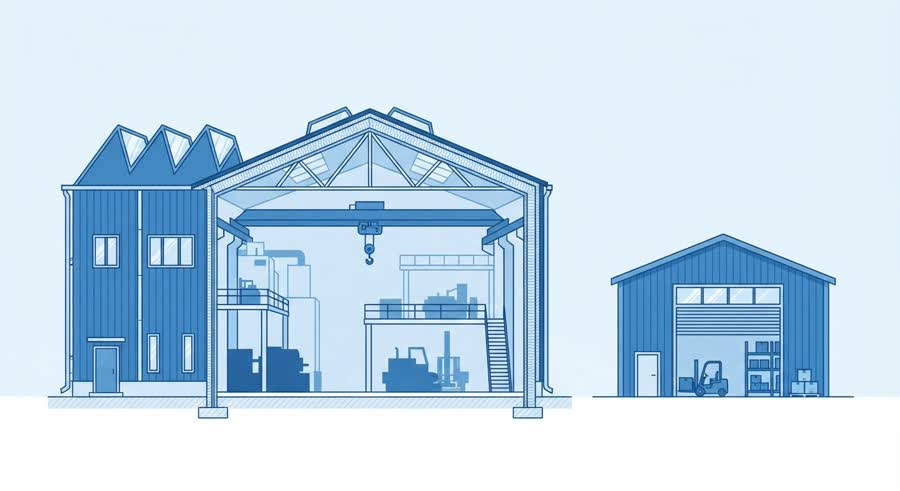
The main factory building was already full with cutting machines, welding workbenches, and material storage space. The representative pointed to a small warehouse building in the back. He said it could easily accommodate one folding machine if we cleared it out. It seemed like there was enough space.
However, when we unfolded the building registry we had received in advance, a problem appeared. While the main building was registered as a 'factory,' the warehouse building was registered as a 'warehouse facility'.
5-2. The 500㎡ Wall and Building Usage
The total floor area of this factory, combining the main building and the warehouse building, was less than 500㎡. If the floor area is 500㎡ or more, a certificate of factory registration is required to prove the production location, but if it's less than 500㎡, the building registry must list the usage as 'factory' or 'manufacturing facility.' Small businesses that manufacture in leased factory buildings or commercial buildings often run into this requirement.
What happens if essential production equipment is placed in a warehouse building? During an inspection, we could receive a notice stating that "production equipment is located in a building not designated for manufacturing." Changing the warehouse building's usage to a factory usage involves architectural drawings, municipal approval, and construction, which would take several months. It was impossible to complete it within the consultation schedule.
5-3. The Fourth Decision — Move the Materials, Not the Machine
That night, I reviewed the factory photos again. The same photo appeared in several shots of the main building. Along one wall were long stacks of raw steel sheets and finished product storage shelves. They occupied nearly a quarter of the main building's area.
The next day, I proposed to the representative: Don't send the machine to the warehouse, send the materials. Use the warehouse building for its original purpose – storing raw materials and finished products – and place the folding machine in the space freed up in the main building. We rearranged the layout so that cutting → folding → welding → assembly would be a continuous line within the main building.
This arrangement also had a side effect. Previously, cut steel sheets were loaded onto a truck and sent to an external company for folding before being welded. Now, it can be done in just a few steps. The representative said that he could shorten the delivery time in proportion to the reduced transportation time.
Ultimately, it wasn't the new machine that solved the problem, but the space to put it.
6. Rearranging the Order — Backwards from the Consultation
6-1. The Fifth Judgment — Countdown Table
The tasks were decided. The problem was the order. Installation of the bending machine, layout changes, conversion of two employees' employment status, reflection of salary reporting, reapplying, inspection, results. Of these, there was almost nothing I could pull forward. Especially, income tax withholding reports accumulate only as the calendar turns.
So, I calculated backwards, using the consultation date as the reference point.
- 3 weeks before the consultation: Target for certificate issuance. Including a buffer period
- 3-4 weeks prior to that: Application for reapplying → Document review → Inspection schedule. The inspection schedule depends on the inspection agency's circumstances, so allow plenty of time
- Just before reapplying: Secure the report for the month in which the two employees' income was reflected in the income tax withholding report, and re-issue the four major insurance registration list as a newly issued version after the application date
- Prior to that: Installation and trial run of the bending machine, relocation to the main office, preparation of employment contracts, and acquisition and reporting of four major insurances
When I drew up the table, I realized that the knot that would be resolved the latest wasn't the machine, but the salary reporting. The machine can be obtained within a week if you spend money. Reporting requires waiting a month. So, I decided to convert the employment status first, and finish it this month. Installing the machine could be done later without delay.
It's easy to read the regulations, but it's difficult to know what to do first.
6-2. How to Organize Outsourced Transactions
There was one more thing I had to take care of. It was the relationship with a nearby company that had been handling bending for nearly 20 years. It’s a transaction that has continued since the representative’s father’s time. It was awkward to abruptly cut it off.
I said to think of public procurement volume and private volume separately. Confirmation of direct production is an obligation for the supply of competing small and medium-sized enterprise products to public institutions. After receiving confirmation, if bending is outsourced again when supplying the item to a public institution, that is a violation of direct production. If a violation is confirmed, it will not only result in the cancellation of the certificate but also lead to disadvantages such as contract termination and restrictions on participation in bidding. It wasn't necessary to organize all the private client volume, but it was important to clearly state the principle that public procurement volume must be handled in our own factory from the beginning. The representative said he went directly to the president of the nearby company to explain the situation.

7. Supplementation and Resubmission
7-1. The Day the Used Folding Machine Arrived
The used folding machine arrived three days later than planned. They said the transport vehicle schedule was delayed. It took the installation technician half a day to drill anchor bolts into the floor and connect the power. The representative documented the installation process with photos and bundled the sales contract and tax invoice into a single file.
The test run was handled by one of the two employees newly enrolled in the four major insurances. He had experience operating a folding machine from his previous job. The representative didn't even know that. He brought it up at a meeting explaining the conversion to regular employment. Now there was someone to answer the question, "Who will operate this machine?" during the on-site inspection.
7-2. The Sixth Judgment — One Sheet of Supplementary Details
The resubmission documents were almost identical to the first application. However, I suggested adding one more sheet. It’s a table titled 'Supplementary Details for Each Previous Reason for Non-Compliance'.
The table had three columns. The leftmost column copied the sentences verbatim from the previous result sheet. The middle column described what was done to resolve that reason. This included the folding machine purchase (specifications, purchase date), relocation of the main unit, conversion of two workers, and acquisition of four major insurances. The rightmost column listed the reference number of the attached documents demonstrating it. The factory layout showed the location of the folding machine, and noted that the warehouse was used for material storage.
Why was this one sheet necessary? The investigator conducting the resubmission inspection already knows the previous results. Therefore, the first thing the investigator will want to confirm is, "Has what was previously pointed out been corrected?" By placing the answer to that question on the first page, the investigator can simply present the table and go through it point by point on-site. This speeds up the verification process and reduces the chance of misunderstandings. It wasn’t a document creating new requirements, but rather a document that shortens the verification path.
7-3. The Seventh Judgment — A Dress Rehearsal Before the Inspection
Once the inspection date was set, the representative and I met at the factory for a preliminary rehearsal. We went through the same steps the investigator would take. Starting at the entrance, we checked each piece of equipment and asked, "Who operates this machine and what process is it used for?"
Two small issues were spotted during that rehearsal. One, a few semi-finished products folded by an external company were stacked next to the folding machine. Although it was a private order, it would have required a lengthy explanation if it had been standing there during the inspection. We moved them to the warehouse. Two, one of the four people listed on the roster had taken a vacation on the scheduled inspection date. We requested a change of date. If the investigator were to check the workforce on-site and they weren't there, we would have to explain it again.
Neither of these was a critical issue that would affect the judgment. However, the inspection takes about an hour. The fewer things there are to explain within that hour, the better.

8. Second Due Diligence
8-1. Where the Investigator Went First
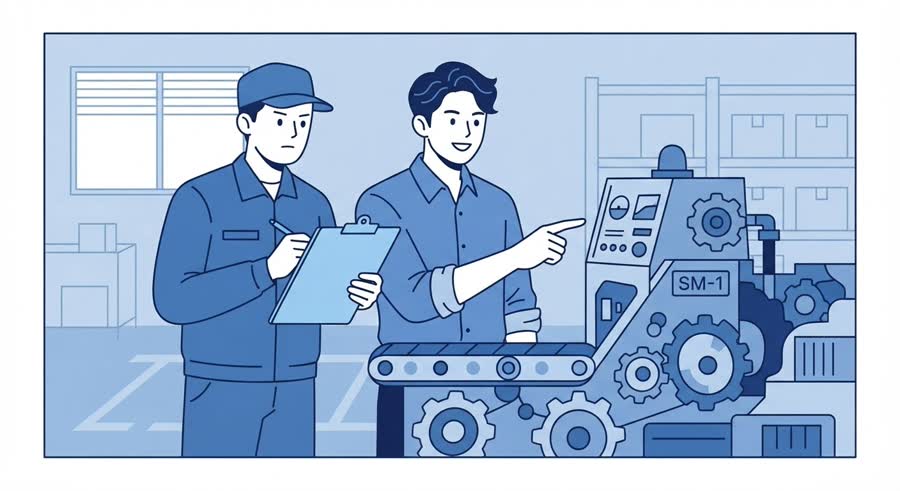
On the day of the second due diligence, the investigator finished greetings and walked into the main building with the supplementary record. It was in front of the bending machine. He checked the dimensions of the nameplate and confirmed that the power was on. And he asked, "Who operates this machine?"
The employee who had been in charge of the test run stepped forward. The investigator had him bend a sheet of iron. The factory was silent as the machine went down and up once. The folded corner was neat.
Next, he checked the personnel records. The investigator called out the names on the roster, confirming each worker and what process they were in charge of. He also looked around the warehouse. He left without comment after seeing the raw materials and finished products piled up. The total time was similar to the first due diligence, about an hour.
8-2. A Nameplate Holder
During the week waiting for the results, the representative visited the office. It was a scheduled document organization appointment. He took a small item out of his bag and placed it on the desk. It was a nameplate holder made from aluminum plate.
He said it was made while test-running the new bending machine. More precisely, it was the third piece. The first one had the angle wrong, and the second was folded too deeply so the nameplate wouldn't fit. Even the third one, if you looked closely, had the left corner slightly more reclined than the right. The representative said it was the best one he’d made.
That nameplate holder is still on the consultation table. The nameplates are stuck in it, slightly tilted.

9. Results — Certificate, and First Bid
9-1. Suitability Assessment and Expiration Date
About ten days later, the results came in: suitable. The direct production confirmation certificate for the relevant item was issued. The validity period is 2 years from the date of issue. There was still about 3 weeks of leeway planned before the consultation.
On the day the certificate was issued, the representative and I did two things first. First, we wrote the certificate expiration date on the calendar. A new validity period begins the day after the expiration date if you reapply within 30 days before the expiration date. We set a reminder for the start date of that 30-day period. Second, we checked the registration information for participation in KONEPS (Korea's public e-procurement system) bidding. We confirmed that the registration category was 'manufactured goods' and that the factory information matched the changes made this time. If the certificate and the procurement registration don't match, we'll be disqualified in the bidding stage.
9-2. Consultation, and Two Bids
The representative took a copy of the certificate and product photos to the autumn consultation. He talked to several procurement officials. There wasn't an immediate contract. Instead, he learned when certain item announcements would be released and what to look for in the specifications.
The first bid was unsuccessful. We were outbid on price. In the second announcement, we secured a small supply of iron storage boxes from a public institution. It wasn't a large amount, but it was the day the factory received its first purchase order with a public institution's name on it. The bending was done, of course, in the factory.
9-3. What the Results Left Behind
Looking back, the biggest change wasn't to the machine. The two people who were working part-time became full-time employees. They were enrolled in employment insurance and national pension, and retirement benefits began to accrue. One of them said that a few months later, he went to a loan consultation and submitted a certificate of employment for the first time.
The effort to receive direct production confirmation ultimately became employment insurance for those two people.
10. After Receiving the Certificate — Validity Period and Post-Management
10-1. 2-Year Validity Period and Renewal Timing
The Direct Production Certification is not a permanent qualification. It is valid for 2 years from the date of issuance. If the validity period of the factory registration expires before this, the certificate's validity period may be shortened accordingly. If you reapply within 30 days before the expiration date, the new validity period will be 2 years from the day after the existing expiration date. If you miss this period and apply after expiration, you will have to go through the same process as a new application, and you will not be able to bid even if an announcement comes out in the meantime.
Procurement qualifications are not just one. They include KONEPS bidding participation qualification registration, industry-related registration, Direct Production Certification, and Small and Medium Enterprise Certification. Each has a different expiration date. Missing even one can prevent you from entering that bid from that day forward. It's more important than you might think to manage all these expiration dates in one place.
10-2. When Moving Factories or Changing Equipment
Direct production is based on a specific location, specific equipment, and specific personnel. Moving production facilities changes the premise of the certificate. In practice, you are advised to return the existing certificate and reapply (including reapplication due to relocation) within 30 days from the date the reason arose. There have been cases where this was missed, resulting in cancellation of the verification and restrictions on applications for a certain period. This is why you should think about the certificate before stamping the lease agreement.
The same applies when selling equipment or reducing personnel. Disposing of essential equipment or having the production workforce fall below the standard while continuing to supply can cause problems in post-delivery inspections.
10-3. The Weight of Direct Production Violations
The most important thing to be careful of is subcontracting at the delivery stage. If you deliver products through subcontracted production after receiving the verification or purchase finished products from another company and deliver them, the Direct Production Certification can be revoked under Article 11 of the Fair Trade Act, and applications may be restricted for a certain period under Article 5 of the same article. Depending on the circumstances, applications may be blocked for all products, not just the specific product, for 6 months. If this is followed by contract termination and restrictions on participation in bidding as an ineligible vendor, the company's procurement business will be suspended for a while.
On the other hand, a decision is not necessarily finalized just because a decision has been made. There have been cases where Direct Production-related decisions have been overturned because the administrative agent failed to sufficiently prove the facts of the violation. However, it is much cheaper to complete the entire process for public procurement products within your own factory from the beginning.
The articles mentioned in this article are translations of the intent of the relevant provisions of the law, and the item-specific verification criteria and detailed procedures may vary depending on the revision of the announcement. Requirements vary from case to case, so verification by the relevant authority is necessary.

11. Frequently Asked Questions (FAQ)
Q1. If I receive an unsuitability assessment in the Direct Production Confirmation Survey, can I reapply immediately?
If the confirmation you received has been canceled, Article 11, Paragraph 5 of the Support for Small and Medium Enterprises Act restricts applications for a certain period. However, if you receive an unsuitable assessment at the application stage, the process is to supplement the reasons for unsuitability and reapply. However, the timing and procedure for reapplying may vary depending on the product and the operating procedures of the investigation agency, so check with your relevant association first. Above all, it is important to resolve every reason listed on the result sheet.
Q2. What is the validity period of the Direct Production Confirmation Certificate, and when do I renew it?
It is 2 years from the date of issuance (it may be adjusted according to the expiration date of the factory registration). If you reapply within 30 days before the expiration date, the new validity period will be 2 years from the day after the existing expiration date. If you apply after expiration, you will go through the same process as a new application, which may prevent you from bidding in public announcements.
Q3. The leased factory is less than 500㎡. Can I apply?
If the total floor area is less than 500㎡, the building permit must show the usage as 'factory' or 'manufacturing facility' instead of a factory registration certificate. Even a leased factory can apply if it meets this usage requirement. Problems may arise if essential equipment is placed in warehouse or commercial facilities, so check the building permit before signing the contract.
Q4. Does direct production count even if part of the process is outsourced?
It depends on the product. The "Direct Production Confirmation Criteria for Products Procured from Small and Medium Enterprises" specifies the production processes and essential production facilities that must be performed directly for each product. Receiving confirmation for one product by outsourcing a certain process does not guarantee the same result for your product. Check the criteria for your application product first.
Q5. An employee is a 3.3% business income earner. Are they considered production personnel?
The review compares the production personnel and payroll payment relationship based on the 4 major insurance business registration list and the withholding tax payment status report. Individuals treated as business income earners may not be confirmed as personnel because they do not appear in the list. If you convert them to employees, apply after ensuring that the list and report refer to the same individuals.

12. What to Check – Practical Checklist
① Start with the confirmation criteria for your product. Essential production facilities, personnel, and processes that must be performed directly vary by product. Also, check the limiting conditions in parentheses after the product name.
② Check the usage of the building permit. For factories less than 500㎡, the building must be designated as a 'factory' or 'manufacturing facility'. Double-check before placing equipment in a warehouse or commercial building.
③ Make sure the list and withholding tax report refer to the same people. The list can be changed in a day, but it takes more than a month for payroll payment records to accumulate.
④ If you receive an unsuitability assessment, create a supplementary record corresponding to each sentence on the result sheet. The next on-site inspection will be shorter.
⑤ Write down the expiration date from the date of receipt of the certificate. Mark the 30-day period before expiration and the 30-day period for return and reapplication when relocating the factory on your calendar.

The two lines in the result table appeared to be different problems. One was a machine, the other a person. But they were both the same question. Is this factory truly making this product on its own? For the documents to answer that question, the factory first had to have the answer. Only after bringing in the machines, rearranging the space, and properly hiring people did the documents begin to say the same thing.
This article is reconstructed based on actual consultation cases, and the characters, names, and figures appearing are not related to any specific individuals or events.
We are an administrative agent office located in Songdo, Incheon (Posco Tower Songdo). We handle administrative litigation, licensing/reporting agency, foreign entry and immigration (visas and residence), and regular administrative management. Procurement procedures, such as direct production confirmation, require field preparation before documents – it’s the fastest way to check item standards, building usage, and personnel documents all at once before applying.
━━━━━━━━━━
Hwang Yun-sang Administrative Agent Office
📍 165, Consia-daero, Yeongsu-gu, Incheon, Posco Tower Songdo 2697
📞 010-3374-2687
🌐 www.hwangadmin.com
━━━━━━━━━━
#DirectProductionConfirmation #DirectProductionConfirmationCertificate #SmallandMediumEnterpriseCompetitiveProducts #DirectProductionConfirmationStandards #On-siteInspection #PublicProcurement #나라장터 (나라장터 - 나라장터 is left as is)
#ProcurementSupportAct #PublicPurchase #ProcurementAdministration #AdministrativeAgent #IncheonAdministrativeAgent #SongdoAdministrativeAgent
If you are curious about similar situations, feel free to leave an inquiry.
※ This is a fictional case reconstructed to aid understanding. [[IMG:N]]