

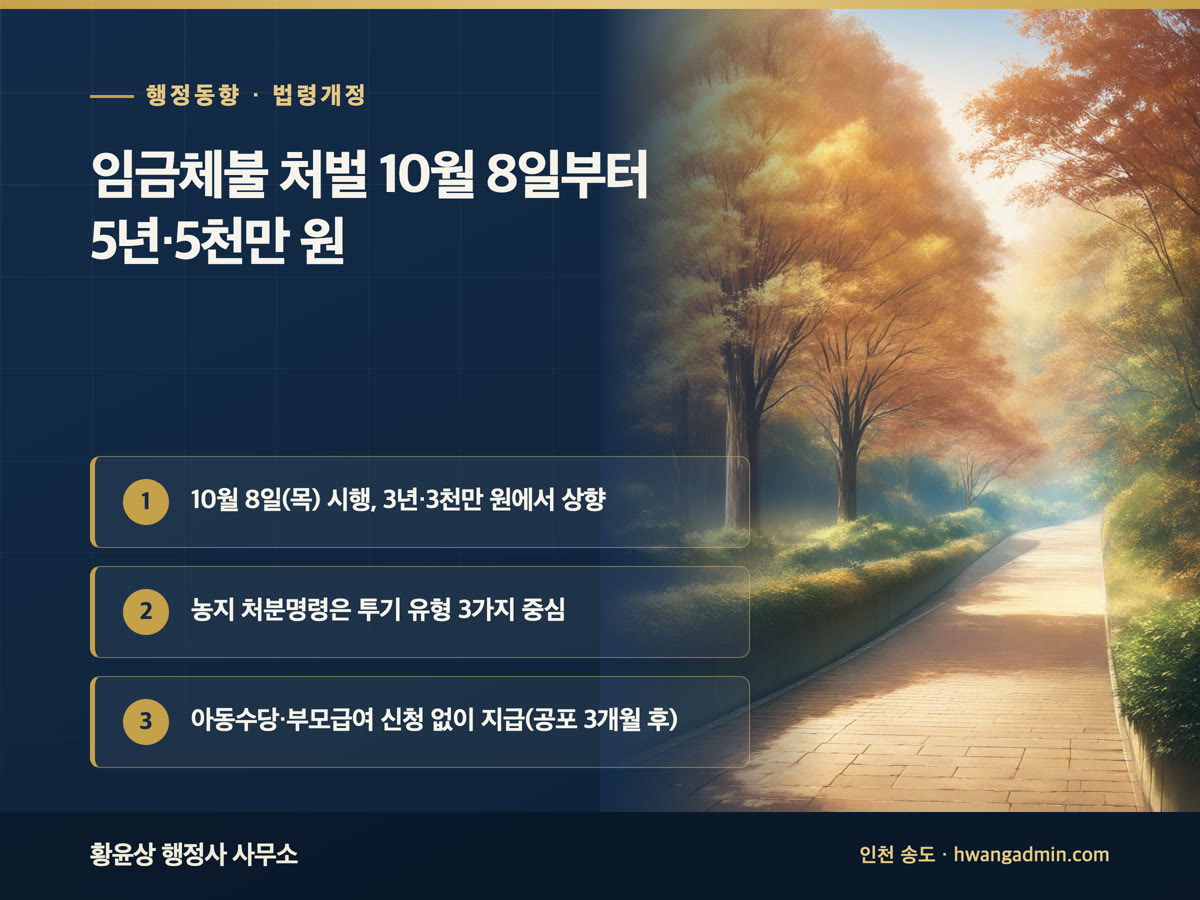
This is the Tuesday morning briefing. We picked the tougher penalty for unpaid wages taking effect this Thursday, the farmland and welfare benefit news the government released over the holidays, and one court ruling on a restaurant business suspension.
Today’s 3 key points
- From Thursday, October 8, the statutory penalty for employers who fail to pay wages rises from 3 years and 30 million won to up to 5 years in prison or a fine of up to 50 million won.
- The Ministry of Agriculture, Food and Rural Affairs said that in the nationwide farmland survey, disposal orders and non-compliance charges will be limited to 3 types of speculation, while other violations will be given a chance to be corrected.
- 6 laws improving the application-based welfare system, which pay child allowance, parental benefit and the First Meeting Voucher without an application, passed the National Assembly on October 1 (effective 3 months after promulgation).
1. Penalty for employers with unpaid wages raised to 5 years and 50 million won, effective October 8

- What changes: The statutory penalty for employers who do not pay wages rises from up to 3 years in prison or a fine of up to 30 million won → up to 5 years in prison or a fine of up to 50 million won. Following the tougher penalty for unpaid retirement benefits that took effect earlier on September 18 (September 16 briefing), the same level now applies to unpaid wages.
- Who it affects: All employers with employees, especially small workplaces that are missing payday due to falling sales.
- When: Takes effect Thursday, October 8, 2026 (Korea Policy Briefing, “Changes taking effect from October”). The amended article number and whether it applies to wages left unpaid before the effective date: ⚠️ need to verify the original.
- A word from the administrative agent: If payment looks likely to be late, notify employees in writing of the expected payment date and amount, and keep records of actual payments (transfer records, pay slips). If you are an employee, gathering your employment contract, wage transfer records and work records will let you use them right away when filing a petition with the competent regional employment and labor office.
- Sources: Korea Policy Briefing · Broader support and more convenient daily life: changes taking effect from October
2. Nationwide farmland survey: disposal orders to focus on 3 types of speculation

- What changes: In explanatory material released on October 2, the Ministry of Agriculture, Food and Rural Affairs set out how cases will be handled after the nationwide farmland survey.
- Subject to disposal orders and non-compliance charges: (1) acquiring farmland by false means in a land transaction permit zone, then leaving it fallow without permission or leasing it illegally; (2) agricultural corporations engaging in real estate business; (3) acquiring co-ownership through auctions and the like, then leaving it fallow without permission or leasing it illegally
- Other violations: no disposal order or non-compliance charge; if the owner wishes, they are given a chance to bring the land into compliance
- Even when a violation is confirmed, unless it is a serious speculative violation, a 1-year voluntary disposal period applies
- If the owner resumes farming the land personally within the disposal obligation period or signs a sale consignment contract with the Farmland Bank, the disposal order is deferred for 3 years, and the disposal obligation lapses once the deferral period ends
- The non-compliance charge of 25% of the farmland value has existed since the 2021 amendment; the 2026 amendment makes it mandatory so local governments can no longer skip the disposal order
- Oral lease agreements without a written contract are also valid, so a lease does not become illegal merely because there is no written document
- Who it affects: People who own farmland through inheritance, leaving farming and so on but do not farm it themselves, and people who lease out farmland or leave it fallow.
- When: The survey is under way. The effective date of the mandatory disposal order under the amended Farmland Act: ⚠️ need to verify the original.
- A word from the administrative agent: Leasing is permitted in cases such as fallowing due to illness or disaster, farmland farmed personally for more than 5 years by a farmer aged 60 or older, and inherited farmland. If you receive a survey notice, check which exception your farmland falls under and prepare supporting documents such as medical certificates and lease records in advance. If you have received a notice of disposal obligation, you should also review within the deadline whether you can obtain a deferral through a sale consignment with the Farmland Bank.
- Sources: Korea Policy Briefing · Ministry of Agriculture, Food and Rural Affairs explanatory material on the nationwide farmland survey (October 2)
3. Child allowance and parental benefit paid without application: 6 laws improving the application-based system pass the National Assembly

- What changes: 6 amendment bills to the Framework Act on Social Security, the Social Security Benefits Act, the Child Allowance Act, the Basic Pension Act, the Disability Pension Act and the National Basic Living Security Act passed the plenary session of the National Assembly on October 1.
- When eligibility can be confirmed with information held by the state or local governments, the person is deemed to have applied, and the review and payment proceed
- Child allowance, parental benefit and the First Meeting Voucher: paid without an application from the guardian; child allowance and parental benefit are paid from the month of birth (payment can be withheld if the guardian does not want it)
- When a disability pension recipient turns 65, they are deemed to have applied for the basic pension; persons with severe disabilities receiving livelihood or medical benefits are deemed to have applied for the disability pension
- For households in crisis, the scope is expanded so that the responsible public official can apply ex officio for livelihood and medical benefits and the like even without consent
- Who it affects: Families having a baby, disability pension recipients turning 65, persons with severe disabilities receiving livelihood or medical benefits, and households in crisis struggling to make a living.
- When: Takes effect on the day 3 months after promulgation. Promulgation date: ⚠️ need to verify the original. The Ministry of Health and Welfare plans to update the subordinate regulations and the social security information system within 3 months.
- A word from the administrative agent: Until the laws take effect, you still need to apply yourself as you do now. If a birth is coming soon, apply for child allowance and parental benefit together with the birth registration so that payments do not start late, and keep in mind that income and asset requirements will still be checked even after the laws take effect.
- Sources: Korea Policy Briefing · The way to apply for welfare benefits is changing, SBS Biz · Child allowance and parental benefit paid even without an application
4. 2-month business suspension upheld even though a minor showed an older brother’s ID: Seoul Administrative Court

- What changes: A restaurant operator who received a 2-month business suspension for selling alcohol to 7 minors sought to have the disposition cancelled, but single-judge Administrative Division 11 of the Seoul Administrative Court dismissed the claim in September (September 19 according to press reports; ruling date ⚠️ need to verify the original).
- 1 of them showed the ID card of an adult older brother, and the other 6 showed certificate screens on their mobile phones.
- The court found that the operator only looked at the age on the ID without comparing the photo with the face, and that a private certificate screen alone cannot be seen as fulfilling the duty to verify age.
- The fact that the business was a means of livelihood was not accepted as a reason to overturn the disposition.
- Who it affects: Operators of general restaurants and bars that sell alcohol.
- When: First-instance ruling (whether it has been appealed: ⚠️ need to verify the original).
- A word from the administrative agent: There is a provision allowing exemption from the disposition when a business could not have known the customer was a minor because of ID fraud (Food Sanitation Act Article 75, ⚠️ need to verify the original text of the article), but to actually be exempted you must show that you checked properly, for example by comparing the photo. Take the physical ID card and compare the photo with the face, and save the checkout counter CCTV footage separately within its retention period. If you have received an advance notice of disposition, please check the deadline for submitting your opinion first.
- Sources: Herald Economy (Daum News) · Business suspended for selling alcohol to students, despite claiming not to know about the brother’s ID
Deadlines to watch this week
- Tuesday, October 6: Up to 5 passports delivered to the same address can be bundled and received by 1 representative recipient
- Thursday, October 8: Statutory penalty of 5 years and 50 million won for employers with unpaid wages takes effect
- Thursday, October 22: Support period for companies approved for business restructuring in supply-stability and industrial-crisis areas extended from 3 years → 5 years
- Thursday, October 29: Income criteria for advance payment of child support abolished; “household member / cohabitant” designation on resident registration certificates takes effect (September 30 briefing)
- Tuesday, November 10 ~ Friday, November 13: Comment deadlines for draft amendments on traffic congestion charges, the Act on the Recovery of Public Finance, essential agricultural materials, the Private Teaching Institutes Act and the Maritime Traffic Safety Act (October 3 and 4 briefings)
This briefing is a guide compiled by Hwang Yunsang Administrative Agent Office based on publicly available information. Whether it applies to an individual case must be confirmed with the competent authority.