

This is the Hangul Day morning briefing. We selected 4 items: 2 legislative pre-announcements posted on the National Participatory Legislation Center on October 8, 1 press release from the Korean National Police Agency, and the issue of managing public-interest direct payments to foreign nationals, revealed through National Assembly materials.
Today’s 3 key points
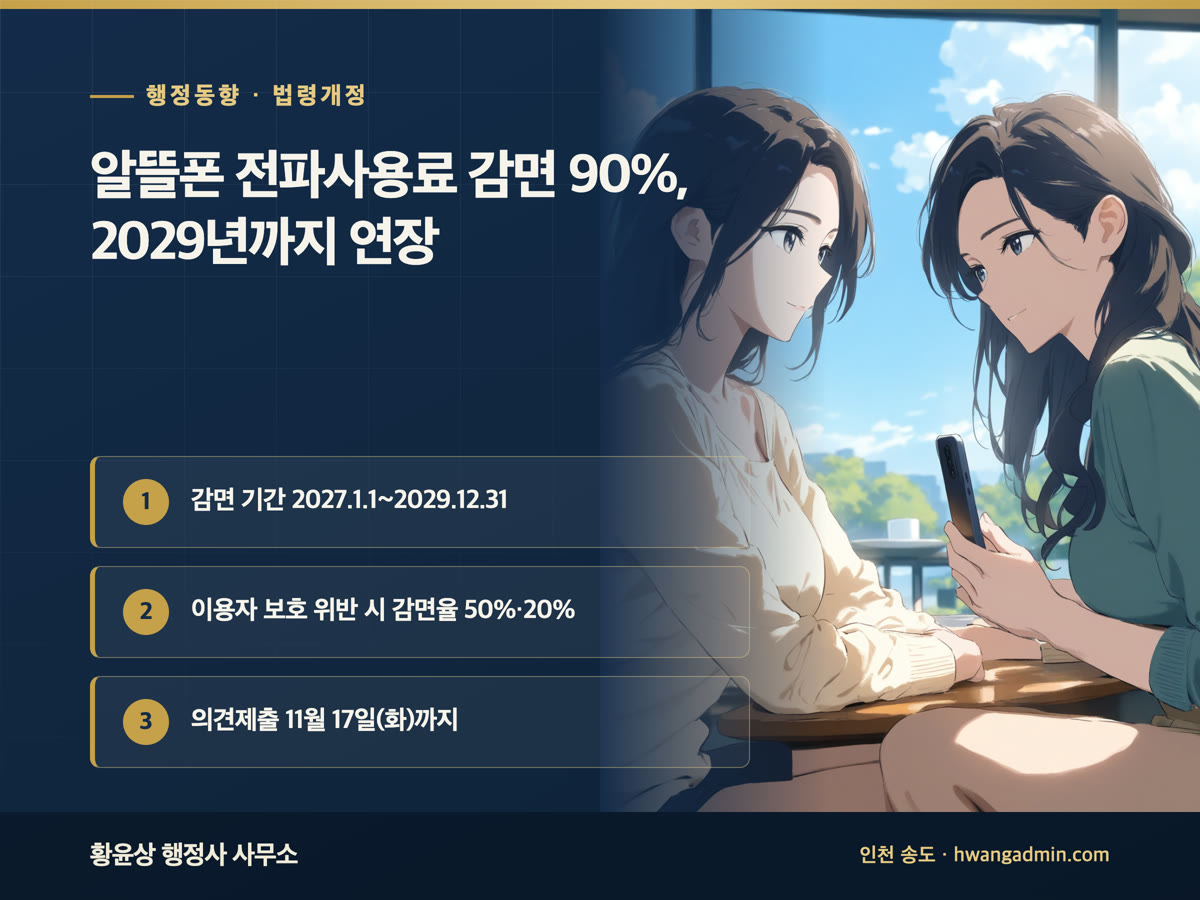
- A draft Enforcement Decree of the Radio Waves Act has been pre-announced, raising the radio spectrum fee reduction rate for small and medium-sized and mid-sized MVNO operators to 90% and extending the reduction period by 3 years, from January 1, 2027 to December 31, 2029.
- A new fee is introduced for petitions to confirm and approve whether a substance is a narcotic, and the narcotics that physicians may not prescribe or administer to themselves are expanded to injectable narcotics and psychotropic drugs.
- A court found that an information disclosure request intended to harass public officials was an abuse of rights and upheld the police’s non-disclosure decision as lawful.
1. MVNO radio spectrum fee reduction expanded to 90% and extended 3 years — Enforcement Decree of the Radio Waves Act pre-announced

- What changes: The Ministry of Science and ICT has pre-announced an amendment to the Enforcement Decree of the Radio Waves Act (draft Article 90).
- For small and medium-sized and mid-sized telecommunications business operators (MVNOs) that receive wholesale services from facilities-based telecommunications operators, the radio spectrum fee reduction rate is expanded to 90%, and the reduction period is set at January 1, 2027 – December 31, 2029.
- Operators that violate the user protection provisions of the Telecommunications Business Act or the information protection provisions of the Network Act will have their reduction rate lowered to 50% or 20% depending on the severity of the violation. Depending on violation history and whether corrections were made, the rate is adjusted within ±10%p for serious violations and ±20%p for minor violations.
- The lowered reduction rate applies for 3 years from the first day of the quarter in which the disposition date falls, and if violations overlap, the lower rate applies.
- Violating operators must submit materials on aggravating or mitigating circumstances to the Ministry of Science and ICT within 10 days from the end of the quarter in which the disposition date falls.
- Who is affected: MVNO operators (small and medium-sized and mid-sized enterprises) and users of MVNO plans.
- When: Comments are accepted until November 17 (Tuesday), and the reduction period starts January 1, 2027. The effective date of the Enforcement Decree: ⚠️ original text needs confirmation.
- A word from the administrative agent: Because the reduction rate will be tied to dispositions for user protection and information protection violations, MVNO operators should review their personal data processing and user notification procedures in advance. If you receive a disposition, the deadline for submitting materials is short — 10 days after the end of the quarter — so record the date you received the disposition notice right away.
- Source: National Participatory Legislation Center · Pre-announcement of the partial amendment to the Enforcement Decree of the Radio Waves Act
2. New fee for petitions to confirm narcotic status; expanded ban on physicians prescribing to themselves

- What changes: The Ministry of Food and Drug Safety has pre-announced an amendment to the Enforcement Rule of the Act on the Control of Narcotics, Etc. It sets out matters delegated by the amended Act (No. 21691, promulgated May 26, 2026).
- It establishes the method and procedure for petitions requesting confirmation of whether a substance is a narcotic, etc. (draft Article 13-2), and creates a fee for petitions for confirmation and approval of narcotic status (draft Article 51 and Annex 3). The fee amount: ⚠️ original text needs confirmation.
- The medical narcotics that physicians may not directly prescribe or administer to themselves are expanded to injectable narcotics or psychotropic drugs (draft Article 35 and Annex 1).
- The method of calculating the reporting period for narcotics incidents reported to the licensing authority is clarified (draft Article 23).
- Even if a violation by a narcotics retailer or narcotics-handling medical practitioner falls under item 9(c) of the individual standards for administrative dispositions, the disposition will be mitigated if it is confirmed that the report was made through external software linked to the Narcotics Information Management System (draft Annex 2).
- Who is affected: Pharmacies (narcotics retailers), hospitals and clinics (narcotics-handling medical practitioners), physicians, and import and manufacturing businesses that need confirmation of narcotic status.
- When: Comments are accepted until November 17 (Tuesday), and the amended Act takes effect on May 27, 2027 (Thursday).
- A word from the administrative agent: If you have received an advance notice of a business suspension for a reporting violation, records of reports made through linked software may be grounds for mitigation, so print out your reporting history first. After a disposition is issued, you may file an administrative appeal within 90 days from the date of receipt.
- Source: National Participatory Legislation Center · Pre-announcement of the partial amendment to the Enforcement Rule of the Act on the Control of Narcotics, Etc.
3. Repeated information disclosure requests intended to harass officials are an abuse of rights; non-disclosure decision upheld

- What changes: According to the Korean National Police Agency, prison inmate A requested “the full text of every information disclosure decision received by Busanjin Police Station during the month of November 2025,” received a non-disclosure decision, and filed a suit to revoke the refusal. On October 1 (Thursday), the 1-3 Administrative Division of the Busan District Court dismissed the claim in its entirety.
- The police station withheld the information because 103 of the 108 decisions in that period were investigation-related materials, and the remaining 5 also raised privacy concerns (Article 9(1)6 of the Official Information Disclosure Act).
- The court found an abuse of rights, citing that the request was made to harass public officials with no intention of using the information, that it was unrelated to the requester’s legal status and could include sensitive private information of third parties, and that redacting personal information item by item would require considerable administrative resources.
- Who is affected: Citizens who request information disclosure, and public institutions handling information disclosure.
- When: This is a first-instance judgment; whether it has been appealed: ⚠️ original text needs confirmation.
- A word from the administrative agent: This ruling concerns mass requests with no clear purpose. When requesting materials you actually need for a disposition or dispute, it is best to state the purpose of use and the required scope specifically in the request. If you receive a non-disclosure decision, you may file an objection within 30 days and an administrative appeal within 90 days from the date of notification.
- Source: Korean National Police Agency · Police win administrative suit over “repeated information disclosure requests intended to harass public officials”
4. Foreign recipients of public-interest direct payments up 93% in 5 years; gaps in residence status checks pointed out

- What changes: According to materials that Representative Lee Sang-hwi of the National Assembly’s Agriculture, Food, Rural Affairs, Oceans and Fisheries Committee received from the Ministry of Agriculture, Food and Rural Affairs, foreign recipients of public-interest direct payments rose 93%, from 187 in 2021 to 361 in 2025, and 350 have applied this year.
- Payments to foreign nationals grew from 394 million won in 2021 to 511.8 million won in 2025, and agricultural business entities with foreign nationals registered grew from 2,568 in 2021 to 4,383 in August 2026.
- The direct payment system does not directly check whether foreign recipients live abroad or have lost their residence status, leaving a gap in verifying residence information between agricultural business entity registration and payment.
- Who is affected: Foreign farmers registered as agricultural business entities (including marriage migrants), and farm households with foreign farmers.
- When: This is at the National Assembly materials stage; the Ministry of Agriculture, Food and Rural Affairs’ timeline for improving the system: ⚠️ original text needs confirmation.
- A word from the administrative agent: If residence information linkage is strengthened, direct payment applications from people whose period of stay has expired or who have been out of the country for a long time may be screened out at the payment stage. Foreign farmers should check their schedule for extending the period of stay or changing residence status, together with their agricultural business entity registration information, before applying for direct payments.
- Source: Prime Gyeongbuk News · Foreign recipients of public-interest direct payments up 93% in 5 years (materials from Rep. Lee Sang-hwi)
Deadlines to watch this week
- October 12 (Monday): Comment deadline for the re-pre-announcement of the Enforcement Rule of the Infectious Disease Control and Prevention Act (succession of disinfection business status) (October 7 briefing)
- October 26 (Monday): Comment deadline for the pre-announcement of the Enforcement Decree of the Foreign Exchange Transactions Act (registration requirements for currency exchange businesses) (October 8 briefing)
- October 29 (Thursday): Comment deadline for the pre-announcement of the Enforcement Decree of the Road Traffic Act (facilities operating children’s school buses) (October 8 briefing)
- November 17 (Tuesday): Comment deadline for the pre-announcements of the Enforcement Decree of the Radio Waves Act (MVNO radio spectrum fees) and the Enforcement Rule of the Narcotics Control Act
This briefing is a guide compiled by the Hwang Yunsang Administrative Agent (Haengjeongsa) Office based on publicly available materials. Whether it applies to an individual case must be confirmed with the competent authority.